Important Information
Investors should not base investment decisions on this material alone. Please refer to the Prospectus for details including the product features and the risk factors. Investment involves risks. Past performance is not indicative of future performance. There is no guarantee of the repayment of the principal. Investors should note:
- The investment objective of Global X China Semiconductor ETF’s (the “Fund”) is to provide investment results that, before fees and expenses, closely correspond to the performance of the FactSet China Semiconductor Index.
- The Fund is exposed to concentration risk by tracking a single region or country.
- The Index constituents may be concentrated in a specific industry or sector, which may potentially more volatile than a fund with a diversified portfolio.
- Semiconductor industry may be affected by particular economic or market events, such as domestic and international competition pressures, rapid obsolescence of products, the economic performance of the customers of semiconductor companies and capital equipment expenditures.
- Investment in Emerging Market, such as A-share market, may involve increased risks and special considerations not typically associated with investments in more developed markets, such as liquidity risk, currency risks, political risk, legal and taxation risks, and the likelihood of a high degree of volatility.
- The Stock Connect is subject to quota limitations. Where a suspension in the trading through the Stock Connect is effected, the Sub-Fund’s ability to invest in A-Shares or access Mainland China markets through the programme will be adversely affected.
- Listed companies on the ChiNext market and/or STAR Board are usually subject to higher fluctuation in stock prices and liquidity risks, over-valuation risk, differences in regulation, delisting risk, and concentration risk.
- There are risks and uncertainties associated with the current Mainland China tax laws, regulations and practice in respect of capital gains realized via Stock Connect on the Fund’s investments in Mainland China. Any increased tax liabilities on the Fund may adversely affect the Fund’s value.
- The trading price of the Fund’s unit on the SEHK is driven by secondary market trading factors, which may lead to a substantial premium or discount to the Fund’s net asset value.
- The Fund’s synthetic replication strategy may invest up to 50% of its net asset value in financial derivative instruments (“FDIs”), which may expose the Fund to counterparty/credit risk, liquidity risk, valuation risk, volatility risk and over-the-counter transaction risk. The Fund may suffer losses from its usage of FDIs.
- The Manager may at its discretion pay dividends out of the capital of the Fund. Distributions paid out of capital, represent a return of an investor’s original investment or its gains and may potentially reduce the Fund’s Net Asset Value per Share as well as the capital available for future investment.
- The Fund may suffer from a losses or delays when recovering the securities lent out. This may potentially affect its ability to meet payment and redemption obligations. Collateral shortfalls due to inaccurate pricing or change of value of securities lent, may cause significant losses to the Fund.
- The investment objective of Global X Hang Seng TECH Covered Call Active ETF (the “Funds”) is to generate income by primarily investing in constituent equity securities in the Hang Seng TECH Index (the “Reference Index”) and selling (i.e. “writing”) call options on the Reference Indexes respectively to receive payments of money from the purchaser of call options (i.e. “premium”).
- If the value of the securities relating to the Reference Index held by the Fund declines, the premium that the Fund received for writing the Reference Index Call Option may reduce such loss to some extent. However, the downside of adopting a covered call strategy is that the Fund’s opportunity to profit from an increase in the level of the Reference Index is limited to the strike price of the Reference Index Call Options written, plus the premium received.
- The market value of an Reference Index Call Option may be affected by factors including supply and demand, interest rates. The Fund’s ability to utilise Reference Index Call Options successfully will depend on the ability of the Manager to correctly predict future price fluctuations.If an Reference Index Call Option expires and if there is a decline in the market value of the Reference Index during the option period, the premiums received by the Fund from writing the Reference Index Call Options may not be sufficient to offset the loss realised.
- The Reference Index Call Options in the OTC markets may not be as liquid as exchange-listed options. The Fund may find the terms of counterparties in the OTC markets to be less favorable than the terms available for listed options. Moreover, the SEHK may suspend the trading of options in volatile markets which may casue the Fund unable to write Reference Index Call Options at times
- The use of futures contracts involves market risk, volatility risk, leverage risk and negative roll yields and “contango” risk.
- Investing in Reference Index Futures and writing Reference Index Call Options generally involve the posting of margin. If the Fund is unable to meet its investment objective as a result of margin requirements imposed by the HKFE, the Fund may experience significant losses.
- The Fund employs an actively managed investment strategy. The Fund may fail to meet its objective as a result of the implementation of investment process which may cause the Fund to underperform as compared to direct investments in the constituent equity securities of the Reference Index.
- The Fund is exposed to concentration risk by tracking a specific regions or countries.
- To the extent that the constituent securities of Reference Index are concentrated in securities of a particular sector or market, the investments of it may be similarly concentrated.
- The trading price of the Fund’s unit on the SEHK is driven by secondary market trading factors, which may lead to a substantial premium or discount to the Fund’s net asset value.
- The Manager may at its discretion pay dividends out of the capital of the Fund. Distributions paid out of capital, represent a return of an investor’s original investment or its gains and may potentially reduce the Fund’s Net Asset Value per Share as well as the capital available for future investment.
- The Fund may suffer from a losses or delays when recovering the securities lent out. This may potentially affect its ability to meet payment and redemption obligations. Collateral shortfalls due to inaccurate pricing or change of value of securities lent, may cause significant losses to the Fund.
- The investment objective of Global X China Core TECH ETF’s (the “Fund”) is to provide investment results that, before fees and expenses, closely correspond to the performance of the Mirae Asset China Tech Top 30 Index.
- The Fund is exposed to concentration risk by tracking a single region or country. It is potentially more volatile than a broad-based fund due to adverse conditions in the region.
- The Index constituents may be concentrated in a specific industry or sector, which may potentially more volatile than a fund with a diversified portfolio.
- The Fund may be exposed to risks associated with different technology sectors and themes. A downturn in these sectors or themes may have adverse effects on the Fund.
- Investment in Emerging Market, such as A-share market, may involve increased risks and special considerations not typically associated with investments in more developed markets, such as liquidity risk, currency risks, political risk, legal and taxation risks, and the likelihood of a high degree of volatility.
- The Stock Connect is subject to quota limitations. Where a suspension in the trading through the Stock Connect is effected, the Sub-Fund’s ability to invest in A-Shares or access Mainland China markets through the programme will be adversely affected.
- Listed companies on the ChiNext market and/or STAR Board are usually subject to higher fluctuation in stock prices and liquidity risks, over-valuation risk, differences in regulation, delisting risk, and concentration risk.
- There are risks and uncertainties associated with the current Mainland China tax laws, regulations and practice in respect of capital gains realized via Stock Connect on the Fund’s investments in Mainland China. Any increased tax liabilities on the Fund may adversely affect the Fund’s value.
- The trading price of the Fund’s unit (the “Unit”) on the SEHK is driven by secondary market trading factors. The Units may trade at a substantial premium or discount to the Fund’s net asset value.
- The Manager may at its discretion pay dividends out of the capital of the Fund. Distributions paid out of capital, represent a return of an investor’s original investment or its gains and may potentially reduce the Fund’s Net Asset Value per Share as well as the capital available for future investment.
- The Fund may suffer from a losses or delays when recovering the securities lent out. This may potentially affect its ability to meet payment and redemption obligations. Collateral shortfalls due to inaccurate pricing or change of value of securities lent, may cause significant losses to the Fund.
- The investment objective of Global X Hang Seng High Dividend Yield ETF (the “Fund”) is to provide investment results that, before deduction of fees and expenses, closely correspond to the performance of the Hang Seng High Dividend Yield Index.
- Whether or not distributions will be made by the Fund is at the discretion of the Manager taking into account various factors and its own distribution policy. There can be no assurance that the distribution yield of the Fund is the same as that of the Index.
- The Fund may invest in mid-sized companies, which may have lower liquidity and their prices are more volatile to adverse economic developments.
- The Fund invests in the emerging markets which may involve increased risks and special considerations not typically associated with investment in more developed markets, such as liquidity risks, currency risks/control, political and economic uncertainties, legal and taxation risks, settlement risks, custody risk and the likelihood of a high degree of volatility.
- The trading price of the Fund’s unit on the SEHK is driven by secondary market trading factors, which may lead to a substantial premium or discount to the Fund’s net asset value.
- The Manager may at its discretion pay dividends out of the capital of the Fund. Distributions paid out of capital, represent a return of an investor’s original investment or its gains and may potentially reduce the Fund’s Net Asset Value per Share as well as the capital available for future investment.
- The Fund may suffer from a losses or delays when recovering the securities lent out. This may potentially affect its ability to meet payment and redemption obligations. Collateral shortfalls due to inaccurate pricing or change of value of securities lent, may cause significant losses to the Fund.
- Global X Asia Semiconductor ETF’s (the “Fund’s”) investment in equity securities is subject to general market risks, whose value may fluctuate due to various factors, such as changes in investment sentiment, political and economic conditions and issuer-specific factors.
- Semiconductor industry may be affected by particular economic or market events, such as domestic and international competition pressures, rapid obsolescence of products, the economic performance of the customers of semiconductor companies and capital equipment expenditures. These companies rely on significant spending on research and development that may cause the value of securities of all companies within this sector of the market to deteriorate.
- Some Asian securities exchanges (including Mainland China) may have the right to suspend or limit trading in any security traded on the relevant exchange. The government or the regulators may also implement policies that may affect the financial markets. Some Asian markets may have higher entry barrier for investments as identification number or certificate may have to be obtained for securities trading. All these may have a negative impact on the Fund.
- The Fund invests in emerging markets which may involve increased risks and special considerations not typically associated with investment in more developed markets, such as liquidity risks, currency risks/control, political and economic uncertainties, legal and taxation risks, settlement risks, custody risk, currency devaluation, inflation and the likelihood of a high degree of volatility.
- The trading price of the Fund’s unit (the “Unit”) on the Stock Exchange of Hong Kong is driven by market factors such as demand and supply of the Unit. Therefore, the Units may trade at a substantial premium or discount to the Fund’s net asset value.
- The Fund’s synthetic replication strategy will involve investing up to 50% of its net asset value in financial derivative instruments (“FDIs”), mainly funded total return swap transaction(s) through one or more counterparty(ies). Risks associated with FDIs include counterparty/credit risk, liquidity risk, valuation risk, volatility risk and over-the-counter transaction risk. FDIs are susceptible to price fluctuations and higher volatility, and may have large bid and offer spreads and no active secondary markets. The leverage element/component of an FDI can result in a loss significantly greater than the amount invested in the FDI by the Sub-Fund.
- As part of the securities lending transactions, there is a risk of shortfall of collateral value due to inaccurate pricing of the securities lent or change of value of securities lent. This may cause significant losses to the Fund. The borrower may fail to return the securities in a timely manner or at all. The Fund may suffer from a loss or delay when recovering the securities lent out. This may restrict the Fund’s ability in meeting delivery or payment obligations from realisation requests.
- The investment objective of Global X Nasdaq 100 Covered Call Active ETF (the “Fund”) is to generate income by primarily (i) investing in constituent equity securities in the NASDAQ-100 Index (the “Reference Index”); and (ii) selling (i.e. “writing”) call options on the Reference Index to receive payments of money from the purchaser of call options (i.e. “”premium”).
- If the value of the securities relating to the Reference Index held by the Fund declines, the premium that the Fund received for writing the Reference Index Call Option may reduce such loss to some extent. However, the downside of adopting a covered call strategy is that the Fund’s opportunity to profit from an increase in the level of the Reference Index is limited to the strike price of the Reference Index Call Options written, plus the premium received.
- The market value of an Reference Index Call Option may be affected by factors including supply and demand, interest rates. The Fund’s ability to utilise Reference Index Call Options successfully will depend on the ability of the Manager to correctly predict future price fluctuations. If an Reference Index Call Option expires and if there is a decline in the market value of the Reference Index during the option period, the premiums received by the Fund from writing the Reference Index Call Options may not be sufficient to offset the loss realised.
- The Reference Index Call Options in the OTC markets may not be as liquid as exchange-listed options. The Fund may find the terms of counterparties in the OTC markets to be less favorable than the terms available for listed options. Moreover, the exchange may suspend the trading of options in volatile markets which may cause the Fund unable to write Reference Index Call Options at times.
- The use of futures contracts involves market risk, volatility risk, leverage risk and negative roll yields and “contango” risk.
- The position of futures or options contracts held by the Manager may not in aggregate exceed the relevant maximum under relevant rules. If the position held or controlled by the Manager reaches the limit or the Fund grow significantly, the Manager will evaluate its position and consider closing out certain positions, which could restrict new share creation and cause the trading price to deviate from NAV.
- Investing in Reference Index Futures and writing Reference Index Call Options generally involve the posting of margin. If the Fund is unable to meet its investment objective as a result of margin requirements imposed by the CME and/or the Fund’s broker, the Fund may experience significant losses.
- The Fund employs an actively managed investment strategy. The Fund may fail to meet its objective as a result of the implementation of investment process which may cause the Fund to underperform as compared to direct investments in the constituent equity securities of the Reference Index.
- The Fund is exposed to concentration risk by tracking the performance of securities in a specific regions or countries.
- To the extent that the constituent securities of Reference Index are concentrated in securities of a particular sector or market, the investments of it may be similarly concentrated.
- The Fund may be exposed to risks associated with different technology sectors and themes. A downturn in these sectors or themes may have adverse effects on the Fund.
- The trading price of the Fund’s unit on the SEHK is driven by secondary market trading factors, which may lead to a substantial premium or discount to the Fund’s net asset value.
- The Manager may at its discretion pay dividends out of the capital of the Fund. Distributions paid out of capital, represent a return of an investor’s original investment or its gains and may potentially reduce the Fund’s Net Asset Value per Share as well as the capital available for future investment.
- The Fund may suffer from a losses or delays when recovering the securities lent out. This may potentially affect its ability to meet payment and redemption obligations. Collateral shortfalls due to inaccurate pricing or change of value of securities lent, may cause significant losses to the Fund.
Global X Select ETFs – January 2026
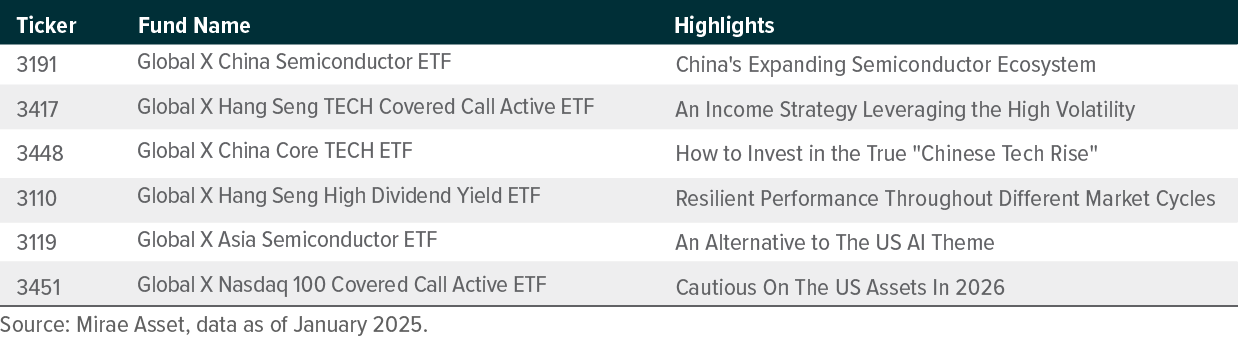
Monthly Select ETF is hybrid contents that combine market strategy and marketing tool. It combines investment ideas suggested by our research team with popular products that are likely to attract customers’ attention.
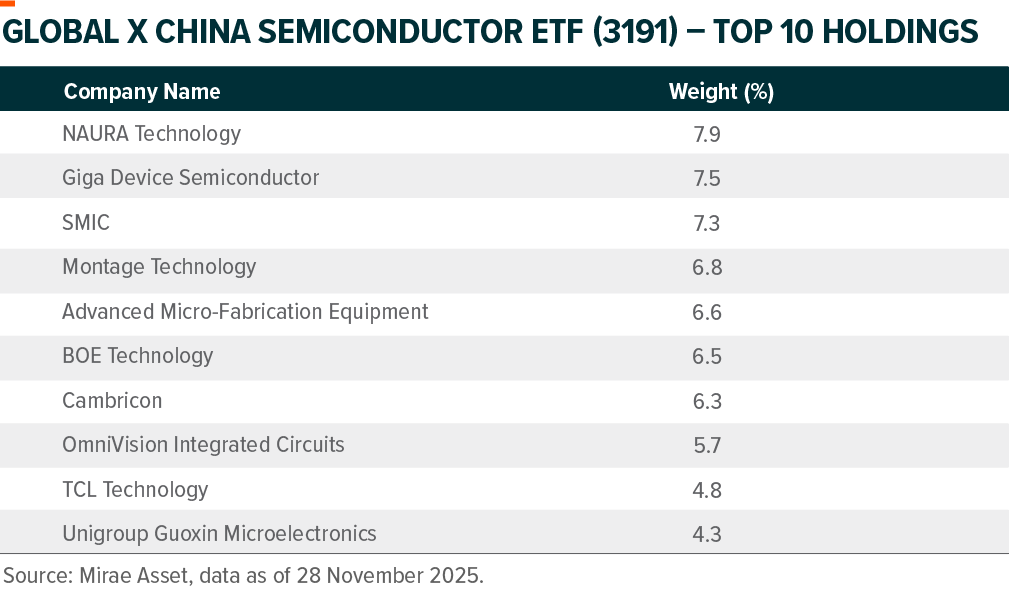
Global X China Semiconductor ETF (3191): China’s Expanding Semiconductor Ecosystem
China’s semiconductor ecosystem is becoming increasingly richer by the day. Recently, fabless companies specializing in AI accelerator design, such as Moore Threads, MetaX, and Biren, have gone public, and large-scale model (LLM) companies like MiniMax and Zhipu are also preparing for listing.
These rapid listings by fabless companies may mean intensified competition for existing index constituents like Cambricon. However, they are also positive in that the funds raised from capital markets serve as a driving force for reinvestment in the overall semiconductor ecosystem. In particular, since the China Semiconductor Index heavily relies on equipment and foundry companies, the increased listing of fabless companies, which are downstream industries, will create a favorable environment for our index constituents.
Risk Factors: Recently, concerns have been raised about the possibility of allowing imports of the NVIDIA H200 into China, raising concerns about a contraction in the Chinese AI chip industry. However, with the Chinese government expected to implement a “quota system” to manage the ratio of domestic and foreign chips, the growth of the local ecosystem is expected to continue.
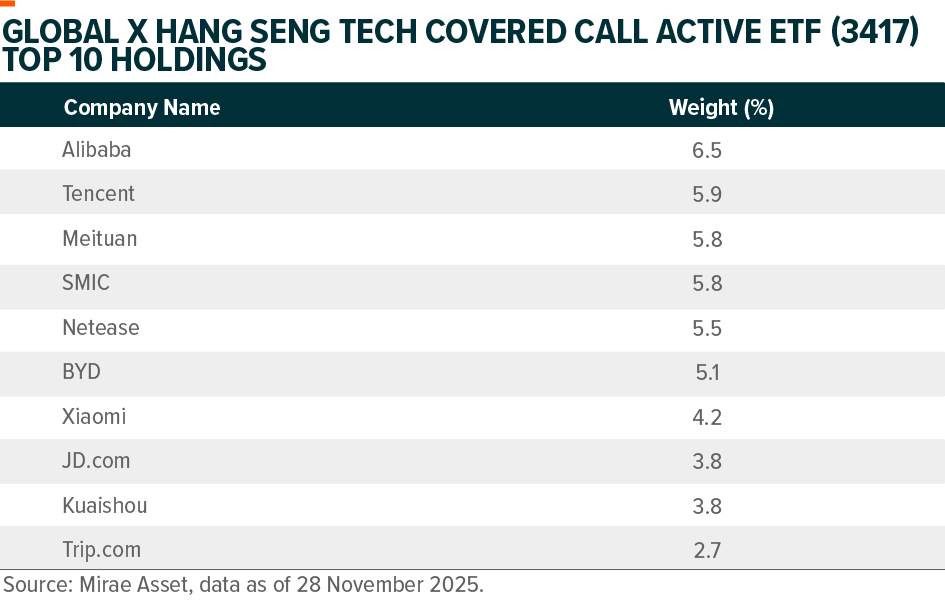
Global X Hang Seng TECH Covered Call Active ETF (3417): An Income Strategy Leveraging the High Volatility
The Hong Kong market is characterized by high volatility compared to other global markets. Expectations for growth in the Chinese tech sector and concerns about sluggish consumption due to the ongoing real estate downturn persist, making the market inherently sensitive to specific news flows.
The “HS Tech Covered Call” product actively capitalizes on this market environment.
Downside Risk Mitigation: Of course, this strategy does not completely eliminate downside risk. However, even when the index declines, option premium income acts as a buffer, allowing for relatively stable income when index fluctuations and premium income are combined.
As a result, this product can be an attractive alternative to simple Chinese tech ETF investments.
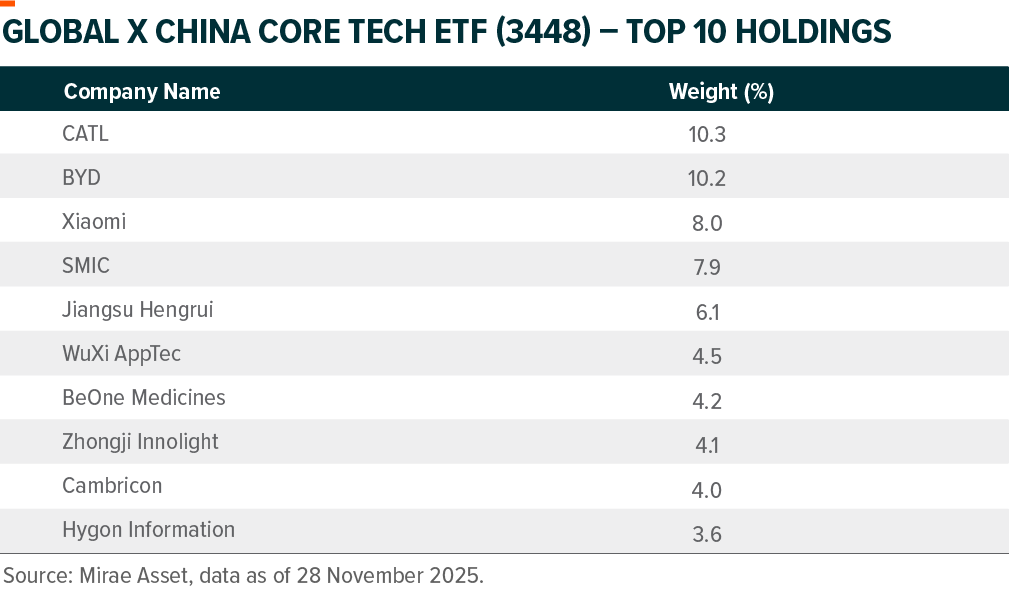
Global X China Core TECH ETF (3448): How to Invest in the True “Chinese Tech Rise”
As we move into 2025, we are witnessing China’s tech rise taking shape across various sectors. The achievements of Huawei in the 7/5nm semiconductor process and the world-class AI model competitiveness demonstrated through “DeepSeek” are just the beginning. In particular, the out-licensing contract size (from Chinese to global big pharma) in the new drug development has doubled year-on-year to $130 billion, demonstrating rapid progress in biotech (Source: National Medical Products Administration (NMPA), January 2026). The battery industry’s overwhelming market dominance and the full-blown development of the robotaxi market are also ongoing. The “China Core Tech ETF” offers the most comprehensive coverage of these truly core technology stocks.
In the past, “China Tech” investment concepts have been broadly categorized into two categories: focusing on internet platform companies, like the US’s KWEB, or tracking the Hang Seng TECH Index. However, these two approaches share a commonality: a significant weighting of the index towards internet companies.
A sober assessment reveals that current Chinese internet companies are closer to ‘general consumer goods’ companies than innovative, growth-driven tech companies. Their business models have matured and are saturated, and constraints on international expansion make it difficult for industrial growth to exceed China’s domestic consumption growth rate (single-digit). From a long-term perspective, we believe that grouping internet companies within the “tech” category is not a particularly sound strategy.
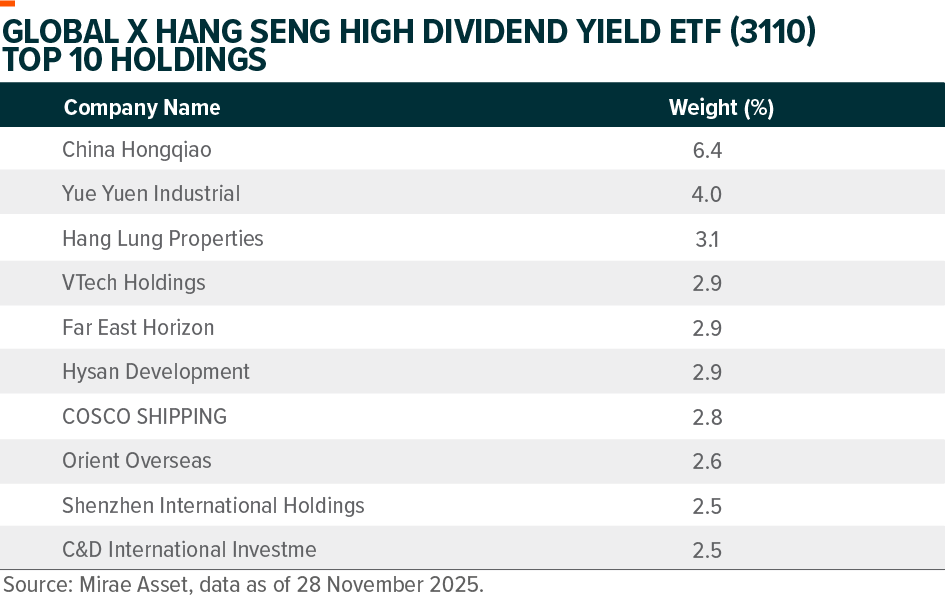
Global X Hang Seng High Dividend Yield ETF (3110): Resilient Performance Throughout Different Market Cycles
Global X Hang Seng High Dividend Yield ETF has consistently outperformed the Hong Kong benchmark index over the past decade (on an annualised basis). While not with explosive returns, it offers long-term performance based on the inherent strengths of a dividend-focused strategy: stable performance. While the aforementioned China Tech-themed ETFs are “exciting” investments with high potential but also high volatility, Hang Seng dividend stocks can provide a balanced portfolio as “calm but steady” investments that quietly maintain their value even during market ups and downs.
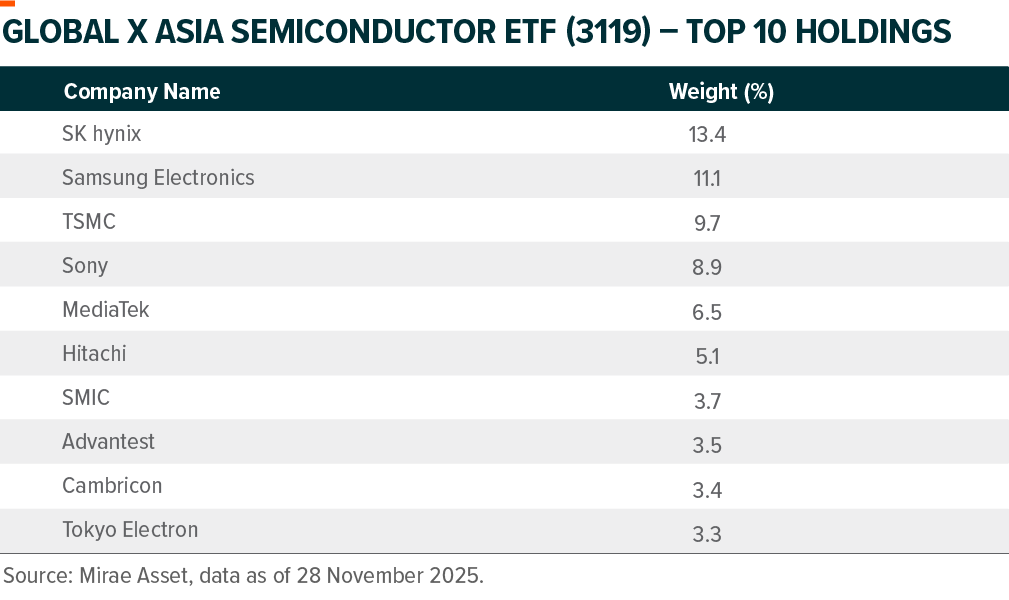
Global X Asia Semiconductor ETF (3119): An Alternative to The US AI Theme
Google’s Gemini’s performance was driven by its custom AI chip, the TPU (Tensor Processing Unit). This suggests the potential for increased demand for custom AI chips (ASICs) in the future, posing a potential threat to NVIDIA, a leader in the general-purpose AI chip market.
TSMC Benefits: TSMC, a foundry (contract semiconductor manufacturer) responsible for producing various custom chips, will benefit from a positive business environment.
Continued HBM Demand: As HBM (High Bandwidth Memory) is a critical component in both general-purpose and custom chips, SK Hynix and Samsung Electronics are expected to continue to benefit. These companies could be attractive alternatives to overvalued US AI stocks.
The current stock prices of US AI-related companies appear to be somewhat overvalued, considering the intense competition among AI models. In contrast, Asian companies in the semiconductor supply chain, primarily in manufacturing (foundries and memory), offer relatively attractive valuations because their growth drivers are not tied to specific model competition but rather are more diversified.
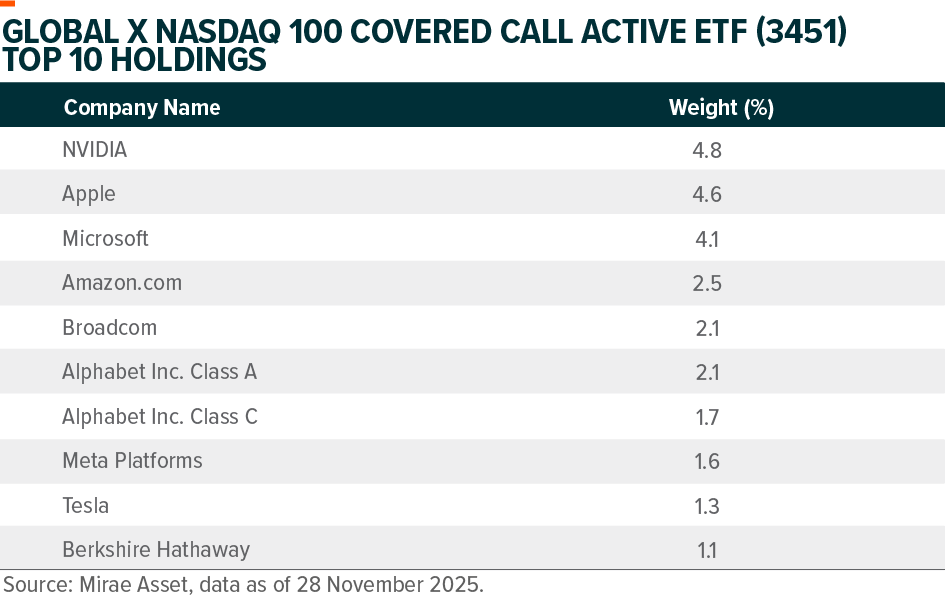
Global X Nasdaq 100 Covered Call Active ETF (3451): Cautious On The US Assets In 2026
2026 is likely to be an inflection point in the decade-long strength of the US dollar and US stocks. We believe it is important to proactively prepare for the potential weakness of dollar assets for the following reasons:
1.Weakening of the Federal Reserve’s Independence
The Trump administration’s strong political influence could hinder the Fed’s independent monetary policymaking. This would suppress interest rate hikes even amidst persistent high inflation, ultimately lowering real interest rates. The high inflation during the Biden administration was largely due to miscalculation by the Federal Reserve, but aggressive interest rate hikes later restored market confidence, pushing the real interest rate to 2.5%, which is core to support the USD. However, the environment in 2026 will be quite different. The combined effects of higher tariffs, expanding fiscal deficits, and low-interest-rate pressure could further lower current real interest rates. (Source: Mirae Asset, Bloomberg, January 2026)
2.The US Dollar is Overvalued Compared to Fundamentals
The US dollar, which has enjoyed a prolonged bull market, is currently overvalued relative to economic fundamentals. If the real interest rate advantage weakens, downward pressure on the dollar is expected to intensify.
3.The Overvalued US Stock Market
There is no doubt that AI will fundamentally transform human life. The market is expected to continue to be dominated by AI-based high-tech stocks, such as autonomous driving and robotics, in 2026.
The current valuations of AI stocks are excessively high. A prime example is OpenAI. As of 2025, it generated approximately $13 billion in revenue, but its expenses reached $30 billion, resulting in a deficit of $16 billion. The company aims to reach $100 billion in revenue by 2029, but to achieve this, it needs to secure at least 300 million paying subscribers at $20 a month. Given its current subscriber base of approximately 10 million and its recent stagnation in active users, this is not a realistically achievable goal at all. Even if OpenAI achieves this number, it will struggle to justify its valuation of over $500 billion, which it was awarded in its 2025 funding round. The forward P/E of the Nasdaq 100 Index currently stands at around 28x, a historic high.
The Nasdaq CC ETF captures an options premium derived from the volatility of the Nasdaq index. For investors with significant exposure to US tech stocks, we recommend hedging risk through a Nasdaq CC strategy.
In particular, the Nasdaq Index generates 50% or more of its constituent stocks’ revenues from overseas markets (Source: Mirae Asset, Factset, January 2026). This will provide a relatively positive impact when the US dollar weakens.









 (852)3555 5888
 Leave Us A Note