Important Information
Investors should not base investment decisions on this material alone. Please refer to the Prospectus for details including the product features and the risk factors. Investment involves risks. Past performance is not indicative of future performance. There is no guarantee of the repayment of the principal. Investors should note:
- The investment objective of Global X S&P Crude Oil Futures Enhanced ER ETF (the “Fund”) is to provide investment results that, before deduction of fees and expenses, closely correspond to the performance of the S&P GSCI Crude Oil Enhanced Index Excess Return.
- As the exposure of the Fund is concentrated in the crude oil market, it is more susceptible to the effects of crude oil price volatility than more diversified funds.
- Crude oil prices are highly volatile and may fluctuate widely and may be affected by numerous events or factors such as crude oil production and sale, complex interaction of supply and demand of crude oil, weather, crude oil inventory level, war, speculator’s activities, Organization of the Petroleum Exporting Countries’ behaviour andcontrol, economic activity of significant crude oil use country and other financial market factors.
- The exposure of the Fund is concentrated in the crude oil market, it is more susceptible to the effects of crude oil price volatility than more diversified funds.
- Investment in futures contracts involves specific risks such as high volatility, leverage, rollover and margin risks.
- The trading price of the Fund’s unit on the SEHK is driven by secondary market trading factors, which may lead to a substantial premium or discount to the Fund’s net asset value.
Why Might Crude Oil ETFs Not Move in Line with Oil Prices? It Starts with the Futures Roll
Tensions in the Middle East persist, and international oil prices have been volatile. Around one-fifth of the world’s petroleum, or about 20 million barrels per day, passes through the Strait of Hormuz1. Market concerns over potential supply disruptions are often quickly reflected in oil prices.
Many investors look to participate in these movements, and convenient ways to do so include buying a crude oil ETF through a Hong Kong securities account. However, some investors find that when news reports say oil prices have risen by 10%, their ETF’s performance differs. In some cases, the ETF may even fall while oil prices rise.
This gap can be significant. In 2009, for example, the WTI crude oil spot price rose by 78% over the year, while an index tracking crude oil futures rose by only 7% over the same period3.
The root of the issue is that what a crude oil futures ETF holds is not the spot oil price reported in the news.
1. What Does a Crude Oil ETF Invest In? Spot Prices vs. Futures Prices
Physically backed gold ETFs can store gold bars in vaults, but crude oil is different: storage requires dedicated facilities, and transportation and insurance costs are high. As a result, most crude oil ETFs reflect oil price movements through crude oil futures contracts.
Futures contracts have expiry dates. An ETF cannot hold the same contract indefinitely; it must sell the contract before expiry and buy a contract with a later expiry month. This process is known as rolling.
The return of a crude oil futures ETF mainly comes from two sources:
- Price changes: the rise or fall in the prices of the contracts held
- Roll gains or losses: the effect of the price difference between the two contracts each time the fund “sells the near-month and buys the later-month” contract
2. What Is Contango? Why May Rolling Lead to Losses?
Contango refers to a market condition in which the prices of later-month futures contracts are higher than those of near-month contracts. Below is a simplified hypothetical example:
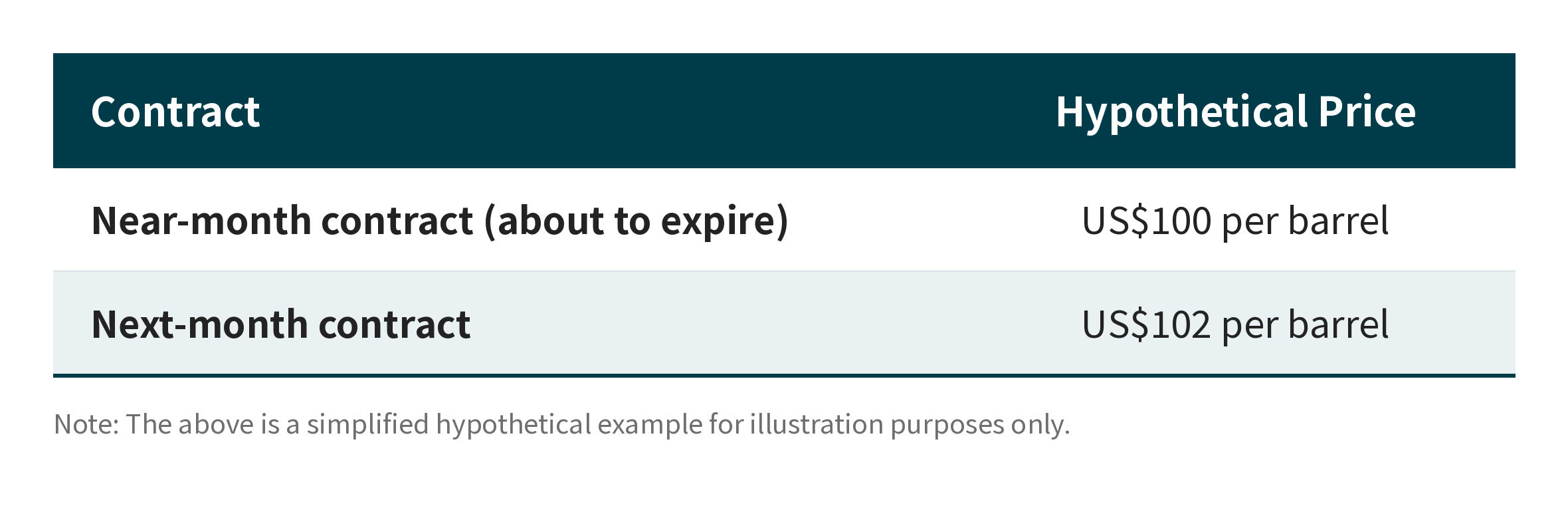
When rolling, the fund sells the near-month contract at US$100 and buys the next-month contract at US$102. With the same amount of capital, it can buy about 2% fewer contracts. Even if oil prices remain unchanged afterwards, this difference may weigh on the fund’s performance. If contango persists, these losses may accumulate with each roll.
Contango tends to occur when the crude oil market is well supplied, inventories are high, or storage costs are rising. This is because surplus crude oil needs to be stored immediately, which puts greater pressure on near-month prices. Later-month prices generally reflect carrying costs such as storage, insurance and financing, and are therefore often higher than near-month prices.
In other words, contango describes the price difference between later-month and near-month contracts. It does not mean that oil prices are rising.
3. What Is Backwardation? Why May Rolling Generate Gains?
Backwardation refers to a market condition in which the prices of later-month futures contracts are lower than those of near-month contracts, the opposite of contango.
Using the example above, if the near-month contract is priced at US$100 and the next-month contract at US$98, the fund “sells high and buys low” when rolling. It can buy more contracts with the same capital, generating a roll gain.
Backwardation tends to occur when supply is tight and immediate demand is relatively strong. Buyers are willing to pay a premium for crude oil available for immediate delivery, which pushes up near-month prices. Later-month prices reflect market expectations that supply and demand may ease in the future, and are therefore relatively lower.
Please note, the shape of the futures curve changes with supply and demand. Contango or backwardation may persist for an unpredictable period3, and past market conditions do not indicate that they will recur.
4. What Is “ER”? Understanding Excess Return Indices
ER (Excess Return) is a calculation method for commodity futures indices that measures only the return from holding the futures contracts themselves.
To understand this, it helps to know one feature of futures: trading futures does not require paying the full contract value, only a margin deposit. The remaining capital is temporarily idle and is typically placed in cash or short-term money market instruments, where it earns interest.
The return from investing in commodity futures can therefore be broken down into three parts:
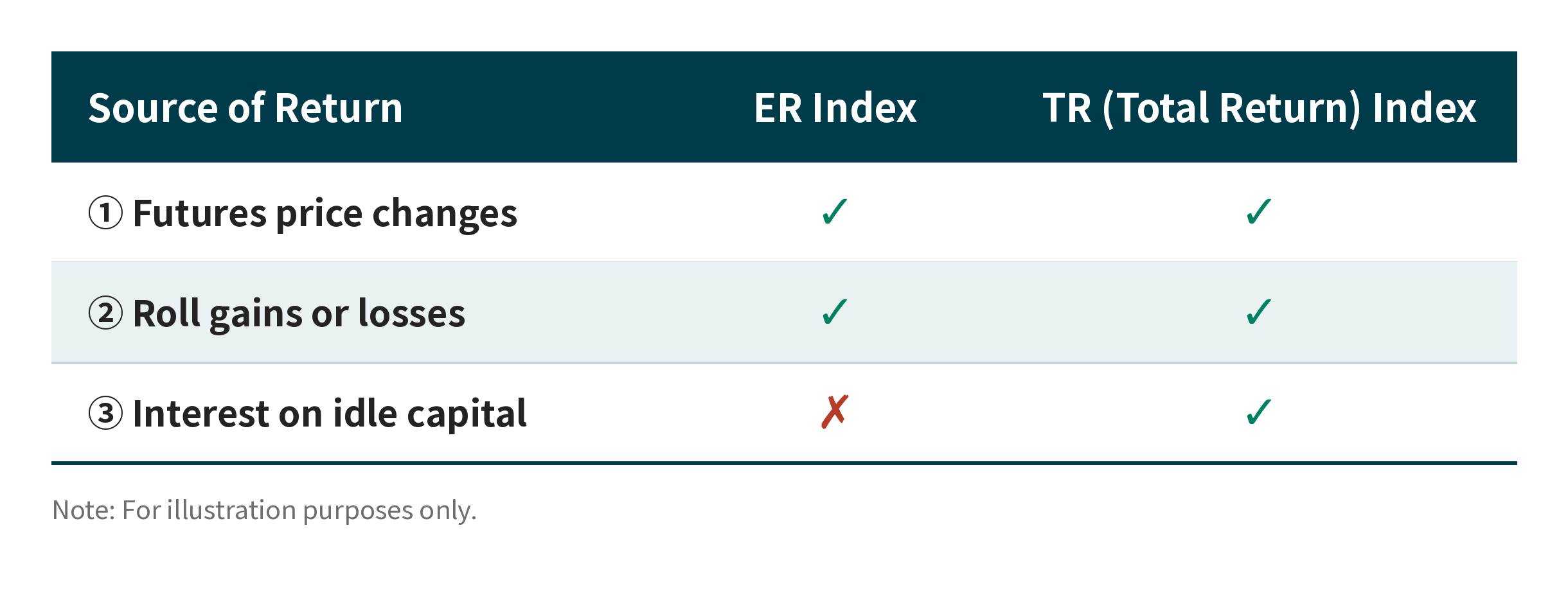
An ER index includes only ① and ②, while a TR index includes all three.
Why is it called “Excess Return”? “Excess” refers to the return beyond cash interest, i.e. the portion derived solely from futures. The term may be read as implying the opportunity to “earn more”, but it does not carry that meaning.
In short, an ER index reflects the performance of simply holding crude oil futures, excluding interest on capital.
5. What to Consider When Choosing a Crude Oil Futures ETF
Products that are all called “crude oil ETFs” can differ considerably in design. Before investing, it may be helpful to consider the following four points:
- Which oil price is tracked? WTI or Brent? The two differ in price and in the factors that affect them.
- Which futures contracts are held? Only the nearest-month contract, or contracts of other months according to set rules?
- How is rolling conducted? Rolling schedules and rules vary across indices, and performance may differ noticeably under contango or backwardation.
- What are the fees and tracking performance? Consider the ongoing charges, tracking difference and bid-ask spread.
6. One Option Among Crude Oil Futures ETFs: Global X S&P Crude Oil Futures Enhanced ER ETF (3097)
For investors who wish to gain exposure to WTI crude oil futures through a Hong Kong securities account, the Global X S&P Crude Oil Futures Enhanced ER ETF (3097) is one option. The fund invests directly in WTI crude oil futures contracts with different expiration dates traded on the New York Mercantile Exchange, and seeks to track the performance of the S&P GSCI Crude Oil Enhanced Index Excess Return2.
Please note that ER (Excess Return) in the ETF’s name does not mean any additional return on the ETF’s performance2. Not less than 80% of the fund’s net asset value is invested in cash, cash equivalents and short-term investment-grade government bonds, and the related yield is used to pay the fund’s fees and expenses2.
“Enhanced” refers to the index’s rolling rule, which adjusts according to the level of contango. Broadly speaking, if the contango between the nearest and next-nearest month contracts is greater than 0.5%, positions are rolled to the current or next year’s December contract. If the contango is 0.5% or less, positions are rolled to the next-nearest month contract2. In other words, the index adjusts the contract months it holds according to the shape of the futures curve. The actual effect depends on market conditions, and there is no guarantee that roll losses will be reduced.
The fund is traded in Hong Kong dollars on the Stock Exchange of Hong Kong2. Investors can trade it through a regular securities account, without opening a separate futures account or handling contract expiry and rolling themselves.
Conclusion
When participating in the crude oil market through an ETF, investors in fact hold futures contracts rather than the spot oil price reported in the news. Understanding how rolling and ER indices work can help explain the gap between crude oil ETFs and oil prices, and help assess whether a product suits one’s needs. Crude oil prices can be volatile, and investors should allocate prudently according to their own investment objectives and risk tolerance.
For more information and risk details, click here: https://www.globalxetfs.com.hk/funds/sp-crude-oil-futures-etf/



 (852)3555 5888

 Leave Us A Note