Important Information
Investors should not base investment decisions on this material alone. Please refer to the Prospectus for details including the product features and the risk factors. Investment involves risks. Past performance is not indicative of future performance. There is no guarantee of the repayment of the principal. Investors should note:
- The investment objective of Global X Nasdaq 100 Covered Call Active ETF (the “Fund”) is to generate income by primarily (i) investing in constituent equity securities in the NASDAQ-100 Index (the “Reference Index”); and (ii) selling (i.e. “writing”) call options on the Reference Index to receive payments of money from the purchaser of call options (i.e. “”premium”).
- If the value of the securities relating to the Reference Index held by the Fund declines, the premium that the Fund received for writing the Reference Index Call Option may reduce such loss to some extent. However, the downside of adopting a covered call strategy is that the Fund’s opportunity to profit from an increase in the level of the Reference Index is limited to the strike price of the Reference Index Call Options written, plus the premium received.
- The market value of an Reference Index Call Option may be affected by factors including supply and demand, interest rates. The Fund’s ability to utilise Reference Index Call Options successfully will depend on the ability of the Manager to correctly predict future price fluctuations. If an Reference Index Call Option expires and if there is a decline in the market value of the Reference Index during the option period, the premiums received by the Fund from writing the Reference Index Call Options may not be sufficient to offset the loss realised.
- The Reference Index Call Options in the OTC markets may not be as liquid as exchange-listed options. The Fund may find the terms of counterparties in the OTC markets to be less favorable than the terms available for listed options. Moreover, the exchange may suspend the trading of options in volatile markets which may cause the Fund unable to write Reference Index Call Options at times.
- The use of futures contracts involves market risk, volatility risk, leverage risk and negative roll yields and “contango” risk.
- The position of futures or options contracts held by the Manager may not in aggregate exceed the relevant maximum under relevant rules. If the position held or controlled by the Manager reaches the limit or the Fund grow significantly, the Manager will evaluate its position and consider closing out certain positions, which could restrict new share creation and cause the trading price to deviate from NAV.
- Investing in Reference Index Futures and writing Reference Index Call Options generally involve the posting of margin. If the Fund is unable to meet its investment objective as a result of margin requirements imposed by the CME and/or the Fund’s broker, the Fund may experience significant losses.
- The Fund employs an actively managed investment strategy. The Fund may fail to meet its objective as a result of the implementation of investment process which may cause the Fund to underperform as compared to direct investments in the constituent equity securities of the Reference Index.
- The Fund is exposed to concentration risk by tracking the performance of securities in a specific regions or countries.
- To the extent that the constituent securities of Reference Index are concentrated in securities of a particular sector or market, the investments of it may be similarly concentrated.
- The Fund may be exposed to risks associated with different technology sectors and themes. A downturn in these sectors or themes may have adverse effects on the Fund.
- The trading price of the Fund’s unit on the SEHK is driven by secondary market trading factors, which may lead to a substantial premium or discount to the Fund’s net asset value.
- The Manager may at its discretion pay dividends out of the capital of the Fund. Distributions paid out of capital, represent a return of an investor’s original investment or its gains and may potentially reduce the Fund’s Net Asset Value per Share as well as the capital available for future investment.
- The Fund may suffer from a losses or delays when recovering the securities lent out. This may potentially affect its ability to meet payment and redemption obligations. Collateral shortfalls due to inaccurate pricing or change of value of securities lent, may cause significant losses to the Fund.
- The investment objective of Global X S&P 500 Covered Call Active ETF (the “Fund”) is to generate income by primarily (i) investing in constituent equity securities in the S&P 500 Index (the “Reference Index”); and (ii) selling (i.e. “writing”) call options on the Reference Index to receive payments of money from the purchaser of call options (i.e. “premium”).
- If the value of the securities relating to the Reference Index held by the Fund declines, the premium that the Fund received for writing the Reference Index Call Option may reduce such loss to some extent. However, the downside of adopting a covered call strategy is that the Fund’s opportunity to profit from an increase in the level of the Reference Index is limited to the strike price of the Reference Index Call Options written, plus the premium received.
- The market value of an Reference Index Call Option may be affected by factors including supply and demand, interest rates. The Fund’s ability to utilise Reference Index Call Options successfully will depend on the ability of the Manager to correctly predict future price fluctuations. If an Reference Index Call Option expires and if there is a decline in the market value of the Reference Index during the option period, the premiums received by the Fund from writing the Reference Index Call Options may not be sufficient to offset the loss realised.
- The Reference Index Call Options in the OTC markets may not be as liquid as exchange-listed options. The Fund may find the terms of counterparties in the OTC markets to be less favorable than the terms available for listed options. Moreover, the exchange may suspend the trading of options in volatile markets which may cause the Fund unable to write Reference Index Call Options at times.
- The use of futures contracts involves market risk, volatility risk, leverage risk and negative roll yields and “contango” risk.
- The Fund employs an actively managed investment strategy. The Fund may fail to meet its objective as a result of the implementation of investment process which may cause the Fund to underperform as compared to direct investments in the constituent equity securities of the Reference Index.
- The Fund is exposed to concentration risk by tracking the performance of securities in a specific regions or countries.
- To the extent that the constituent securities of Reference Index are concentrated in securities of a particular sector or market, the investments of it may be similarly concentrated.
- The trading price of the Fund’s unit on the SEHK is driven by secondary market trading factors, which may lead to a substantial premium or discount to the Fund’s net asset value.
- The Manager may at its discretion pay dividends out of the capital of the Fund. Distributions paid out of capital, represent a return of an investor’s original investment or its gains and may potentially reduce the Fund’s Net Asset Value per Share as well as the capital available for future investment.
- The Fund may suffer from a losses or delays when recovering the securities lent out. This may potentially affect its ability to meet payment and redemption obligations. Collateral shortfalls due to inaccurate pricing or change of value of securities lent, may cause significant losses to the Fund.
1-Year Anniversary: the Nasdaq 100 Covered Call ETF (3451 HK)
It has been one year since the Global X Nasdaq 100 Covered Call Active ETF (3451 HK) was launched on 30 September 2025. Let’s recap how the product performed over its first year and what it means for your asset allocation.
Performance Review
If you reinvested distributions you earned into the fund, the ETF gained [Fund inception date: Sep 30, 2025. CY 2025 Total Return since first trading day: 6.80%; YTD 2026 Total Return: 12.8%]. While this return was lower than the reference index Nasdaq 100, which rose by about 23.8% during the same period, the ETF did exactly what a “covered call strategy” was designed to do.
[Table1] one year performance comparison since the launch of 3451 HK

(Source) Bloomberg, (Note) Total return assumes reinvestment of the distribution paid
A “covered call” is an investment strategy where the fund buys shares of companies in an index and sells call options on those shares to collect option premium. Investors usually choose the strategy for below reasons:
- Managing Volatility: when you believe the underlying asset will grow in the long run but are worried about high volatility.
- Downside Cushion: You get decent cash income from selling options. This cash acts as a cushion to protect your portfolio if the market drops.
However, because the strategy sets a ceiling on your potential upside gains, it will naturally lag behind the underlying asset during periods of strong market rallies.
This is exactly what happened with the ETF over the past year. The ETF outperformed the reference index during market downturns (such as February and March 2026), while it underperformed when the index rallied (such as April 2026).
[Chart] One–year performance chart of 3451 HK and NASDAQ 100 Index
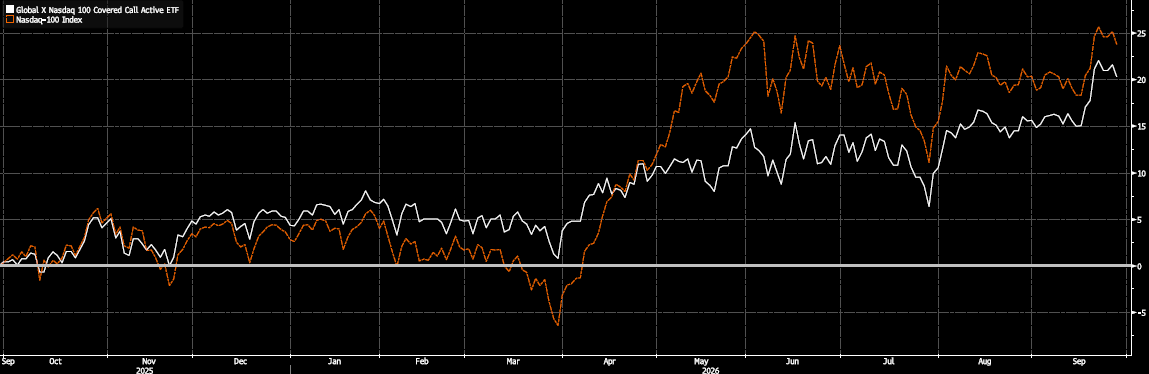
(Source) Bloomberg
1-Year review of Nasdaq 100 Index and its implication
Despite recent worries that the AI boom might be slowing down, the Nasdaq 100 index still delivered strong returns over the past year. How did this happen when many believed AI was already fully priced in? The answer lies in a big split within the tech sector:
- Software companies that are at risk of being replaced or hurt by new AI technologies saw their stock prices move in a high volatility.
- However,cloud service providers completely made up for those losses. Amazon, Alphabet, and Microsoft saw an explosion in cloud revenues because businesses are rushing to buy AI infrastructure.
[Table] Cloud service providers’ latest quarterly revenue growth
| Company | Cloud Name | Cloud Division Growth (YoY) | Total Company Growth (YoY) |
|---|---|---|---|
| Microsoft | Azure, Copilot | 32% | 17% |
| Amazon | AWS | 37% | 20% |
| Alphabet | Google Cloud | 82% | 24% |
(Source) Bloomberg, Oct 2026
We expect this type of reshuffling to continue. In the AI era, some older tech businesses will lose ground, but new innovators within the Nasdaq 100 will find new ways to generate revenue and push the broader index forward.
At the same time, this continuous shuffling will keep market volatility high, which means our Covered Call ETF is well positioned to keep collecting premiums for its investors.
Why a Covered Call Strategy Makes Sense for the US Equity Investment
Going forward, we believe the Global X Nasdaq 100 Covered Call Active ETF (3451 HK) remains a solid investment strategy today because of three key trends:
- Established Underlying Companies: The Nasdaq 100 is made up of the world’s leading tech leaders like NVIDIA, Alphabet, Microsoft, Apple, Amazon, and SpaceX.
- Elevated Valuations: After a powerful bull market lasting more than 10 years, the underlying stocks’ valuations have become elevated, making it harder for investors to find attractive entry points
- Macro Uncertainty: Macroeconomic headwinds, such as expanding U.S. government debt and sticky inflation, are keeping investors on edge and creating frequent bouts of market volatility.
When stock prices are no longer cheap and the market is volatile, a covered call strategy truly shines. Instead of just hoping for stock prices to keep climbing, this strategy allows you to generate steady, reliable cash flow from the market volatility.
An Extra Benefit: Tax Efficiency for Hong Kong Investors
Beyond the market outlook, this ETF offers an advantage: it saves you money on taxes.
Because this product is based and listed on the Hong Kong Stock Exchange (SEHK), it offers greater tax benefits for Hong Kong and international investors than buying a fund listed or domiciled in the United States:
- S. domicile funds: If you buy a covered call strategy fund domiciled or listed in the U.S., the American government treats your (monthly) distribution income as “regular dividends” and automatically deducts a 30% tax on the distributions, right at the source.
- HK-Listed ETF (like 3451 HK and 3415 HK): In contrast, the (monthly) distribution you receive from these Hong Kong-listed covered call ETFs are fully exempt, meaning you pay no distribution tax at the investor level.




 (852)3555 5888
 Leave Us A Note