Important Information
Investors should not base investment decisions on this material alone. Please refer to the Prospectus for details including the product features and the risk factors. Investment involves risks. Past performance is not indicative of future performance. There is no guarantee of the repayment of the principal. Investors should note:
- The investment objective of Global X Hang Seng TECH ETF (the “Fund”) is to provide investment results that, before deduction of fees and expenses, closely correspond to the performance of the Hang Seng TECH Index.
- The Fund is exposed to concentration risk by tracking a specific regions or countries.
- The Index constituents may be concentrated in a specific industry or sector, which may potentially more volatile than a fund with a diversified portfolio.
- The Fund’s investments are concentrated in companies with a technology theme. Technology companies are often characterised by relatively higher volatility in price performance. Companies in the technology sector also face intense competition, and there may also be substantial government intervention, which may have an adverse effect on profit margins. These companies are also subject to the risks of loss or impairment of intellectual property rights or licences, cyber security risks resulting in undesirable legal, financial, operational and reputational consequences.
- The trading price of the Fund’s unit on the SEHK is driven by secondary market trading factors, which may lead to a substantial premium or discount to the Fund’s net asset value.
- The Manager may at its discretion pay dividends out of the capital of the Fund. Distributions paid out of capital, represent a return of an investor’s original investment or its gains and may potentially reduce the Fund’s Net Asset Value per Share as well as the capital available for future investment.
- The Fund may suffer from a losses or delays when recovering the securities lent out. This may potentially affect its ability to meet payment and redemption obligations. Collateral shortfalls due to inaccurate pricing or change of value of securities lent, may cause significant losses to the Fund.
- The investment objective of Global X Hang Seng TECH Covered Call Active ETF (the “Fund”) is to generate income by primarily investing in constituent equity securities in the Hang Seng TECH Index (the “Reference Index”) and selling (i.e. “writing”) call options on the Reference Indexes respectively to receive payments of money from the purchaser of call options (i.e. “premium”).
- If the value of the securities relating to the Reference Index held by the Fund declines, the premium that the Fund received for writing the Reference Index Call Option may reduce such loss to some extent. However, the downside of adopting a covered call strategy is that the Fund’s opportunity to profit from an increase in the level of the Reference Index is limited to the strike price of the Reference Index Call Options written, plus the premium received.
- The market value of an Reference Index Call Option may be affected by factors including supply and demand, interest rates. The Fund’s ability to utilise Reference Index Call Options successfully will depend on the ability of the Manager to correctly predict future price fluctuations.If an Reference Index Call Option expires and if there is a decline in the market value of the Reference Index during the option period, the premiums received by the Fund from writing the Reference Index Call Options may not be sufficient to offset the loss realised.
- The Reference Index Call Options in the OTC markets may not be as liquid as exchange-listed options. The Fund may find the terms of counterparties in the OTC markets to be less favorable than the terms available for listed options. Moreover, the SEHK may suspend the trading of options in volatile markets which may casue the Fund unable to write Reference Index Call Options at times
- The use of futures contracts involves market risk, volatility risk, leverage risk and negative roll yields and “contango” risk.
- Investing in Reference Index Futures and writing Reference Index Call Options generally involve the posting of margin. If the Fund is unable to meet its investment objective as a result of margin requirements imposed by the HKFE, the Fund may experience significant losses.
- The Fund employs an actively managed investment strategy. The Fund may fail to meet its objective as a result of the implementation of investment process which may cause the Fund to underperform as compared to direct investments in the constituent equity securities of the Reference Index.
- The Fund is exposed to concentration risk by tracking a specific regions or countries.
- To the extent that the constituent securities of Reference Index are concentrated in securities of a particular sector or market, the investments of it may be similarly concentrated.
- The trading price of the Fund’s unit on the SEHK is driven by secondary market trading factors, which may lead to a substantial premium or discount to the Fund’s net asset value.
- The Manager may at its discretion pay dividends out of the capital of the Fund. Distributions paid out of capital, represent a return of an investor’s original investment or its gains and may potentially reduce the Fund’s Net Asset Value per Share as well as the capital available for future investment.
- The Fund may suffer from a losses or delays when recovering the securities lent out. This may potentially affect its ability to meet payment and redemption obligations. Collateral shortfalls due to inaccurate pricing or change of value of securities lent, may cause significant losses to the Fund.
Why HSTECH is Lagging
Recently, the Hang Seng Tech Index has significantly underperformed broader global equity assets—posting a YTD total return of -21.1%, a 3-year cumulative return of 17.7%, and a 3-year CAGR of 5.6%, which trails both the Hang Seng Index and the Nasdaq 100 Index (at 21.8% YTD, 112.8% 3-year cumulative, and 28.6% 3-year CAGR)—drawing widespread market attention. Although it bears the word “technology,” the underlying asset structure, profit realization cycle, and macroeconomic environment of the index dictate its inevitable cyclical pressure.
Index Performance Comparison
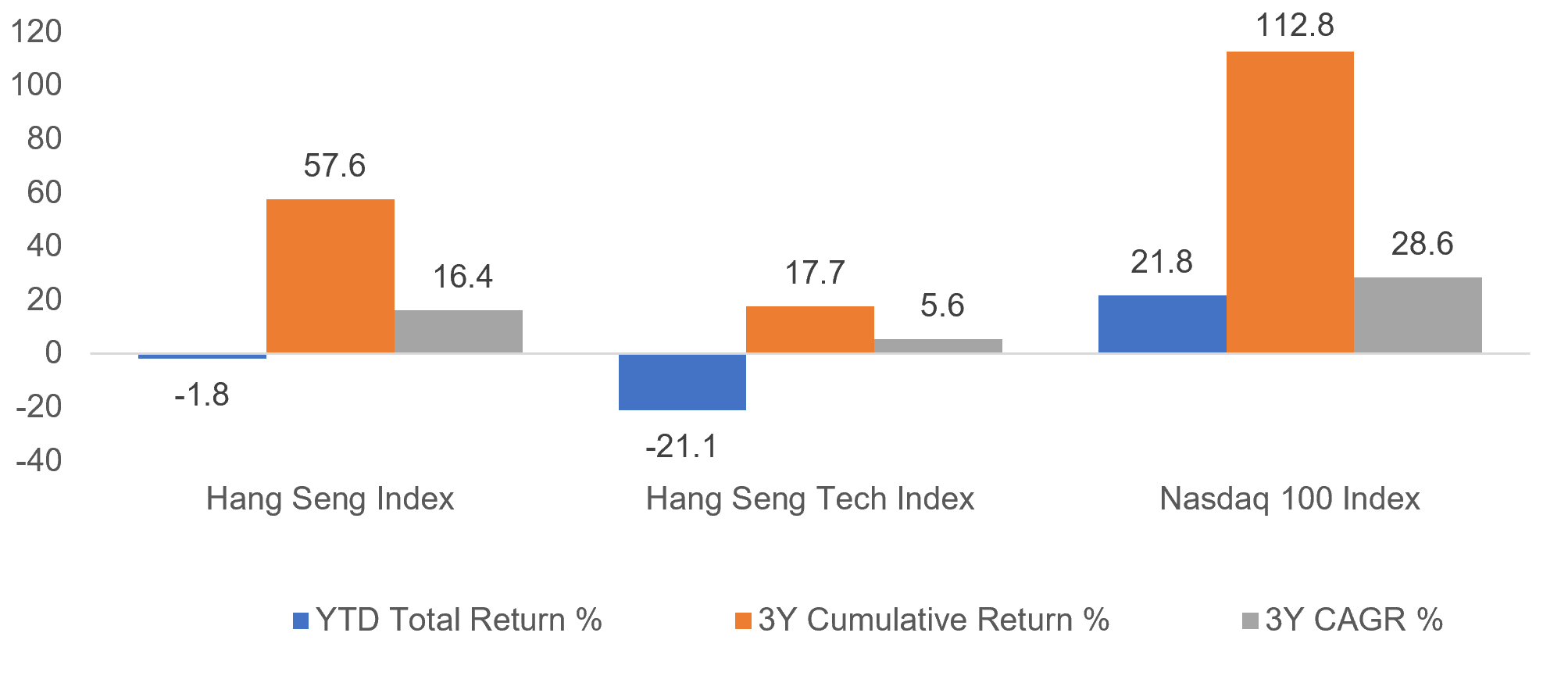
Source: Factset, Sep 28, 2026. The cumulative total return period is between Mar 13, 2025, and Sep 28, 2026.
We analysed four core elements resonated the weak performance of the Hang Seng Tech Index.
Consumer-Heavy Weighting and Weak Domestic Demand
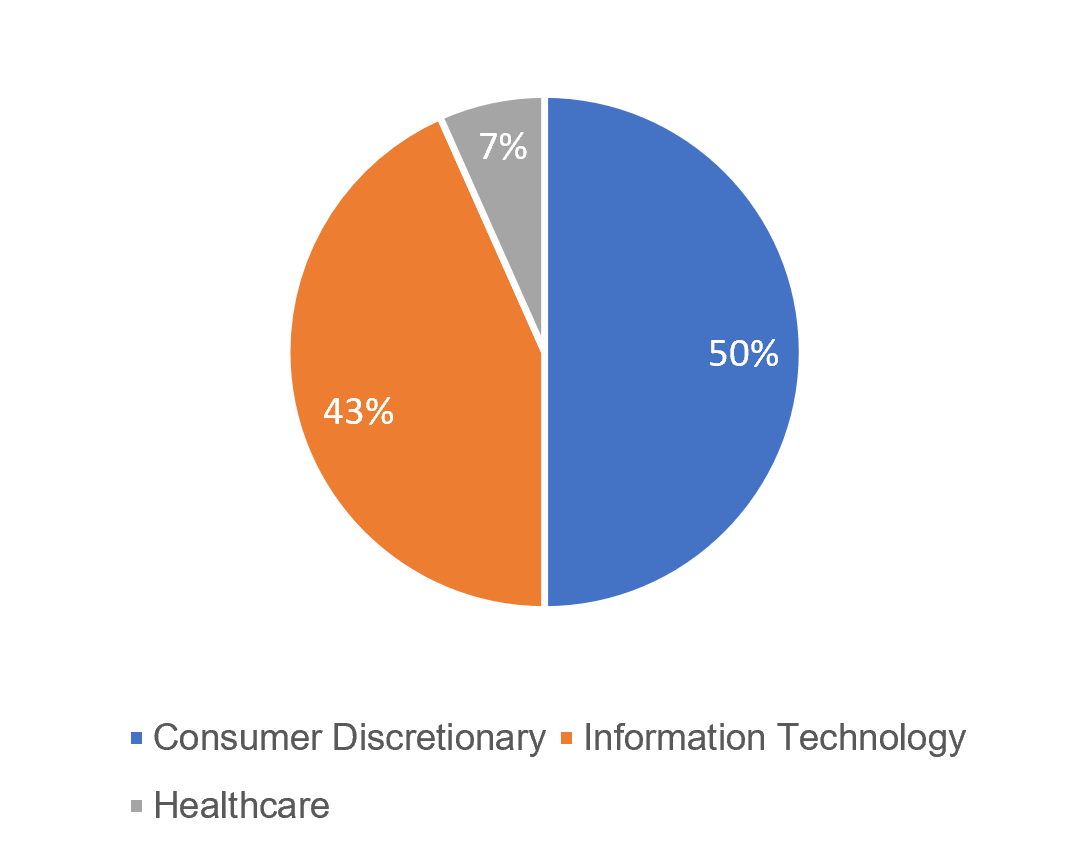
Despite being widely viewed as a pure hard-tech index, or a “Nasdaq of the East,” the Hang Seng TECH Index is actually heavily weighted toward consumer sectors. As of September 2026, the index is led by Consumer Discretionary at 50%, followed by Information Technology at 43.3% and Healthcare at 6.7%.
Amid a mild domestic macroeconomic recovery, residents’ marginal propensity to consume remains cautious. Intense price competition in local life services and traffic saturation in traditional e-commerce have directly pressured the revenue growth and profit margins of key constituents.
With its “technology coat and consumer core,” the index cannot fully capture the dividends of a global tech bull market; instead, it remains highly sensitive to domestic retail sales and consumption trends. Because HSTECH is deeply tied to China’s new-economy consumption and internet platforms, sluggish domestic demand serves as the primary barrier to its valuation recovery.
| HSTECH Sector Allocation (Sep 2026) | China Key Economic Indicators |
 |
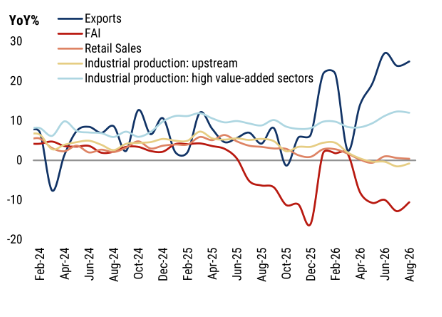 |
| Source: Hang Seng Index, Mirae Asset Global Investments (HK). | Source: CEIC, Morgan Stanley, Sep 2026. |
Internet Giants: Growth Maturation and Valuation Reset
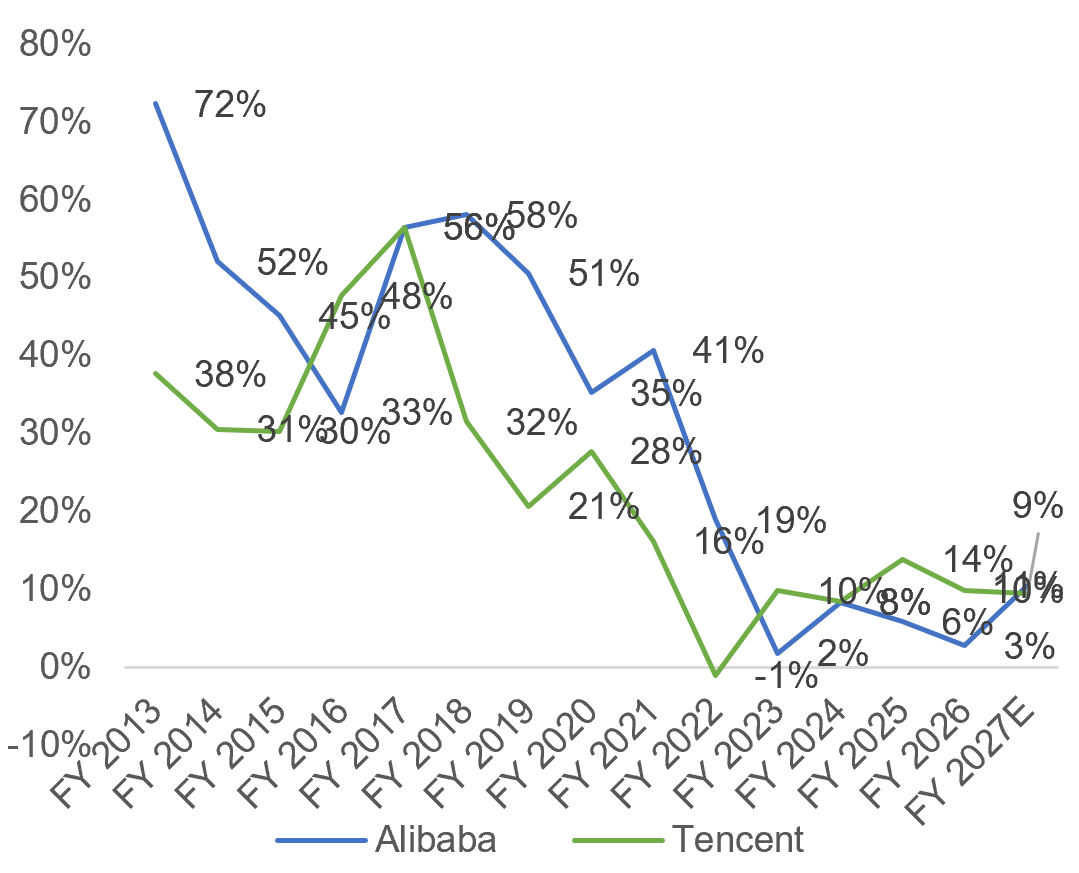
As the revenue growth rates of leading internet enterprises moderate from historic double-digit expansion down to single-digit ranges, the market’s pricing framework has officially transitioned from a “high-growth, high-valuation” model to a mature-phase value assessment. This structural shift has induced a phased wait-and-see sentiment among both growth and value allocators, resulting in broad multiple compression.
| Revenue Trend, Growth YoY % | Net Income Trend, Growth YoY % |
 |
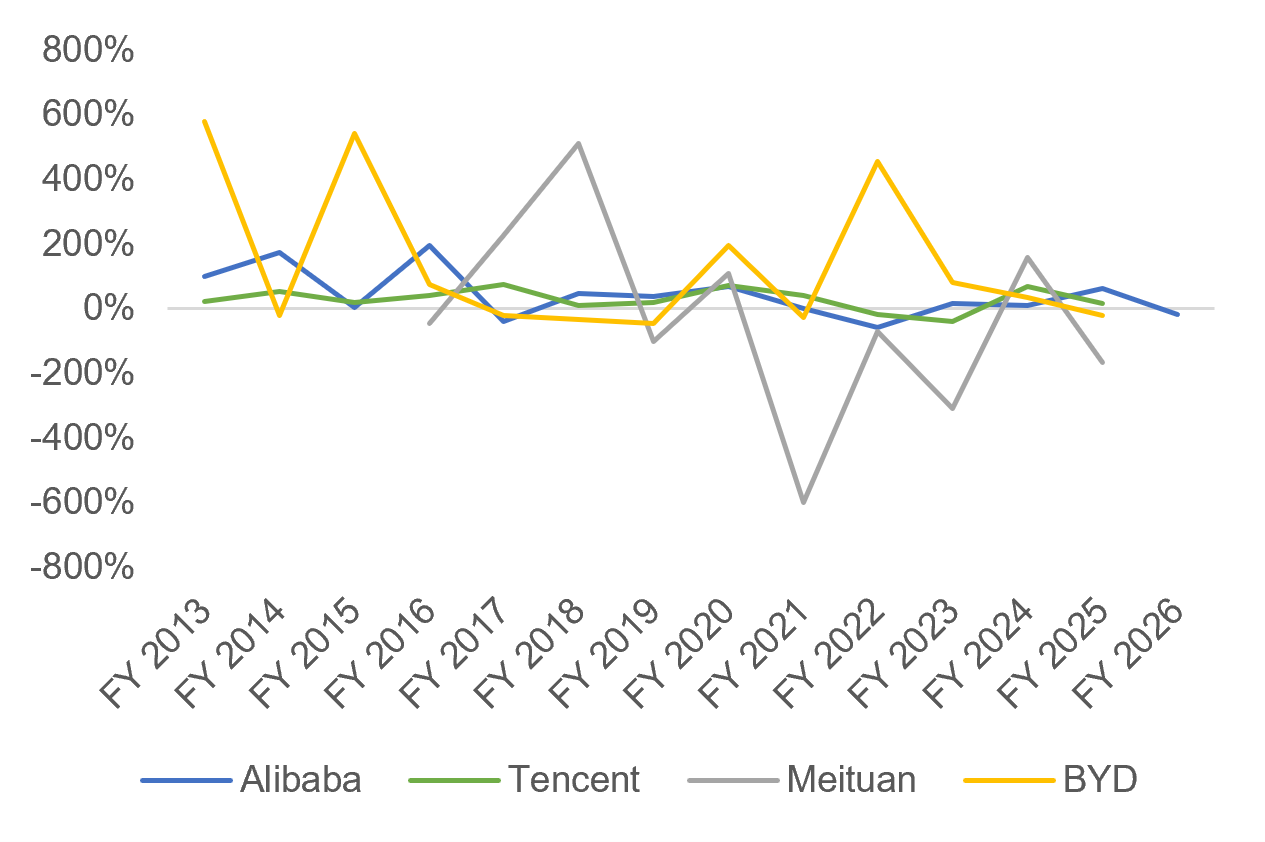 |
| Source: Bloomberg, Mirae Asset Global Investments (HK). | Source: Bloomberg, Sep 2026. |
Note: Alibaba (2027E) and Tencent (2026E–2027E) revenue growth figures are based on Bloomberg Consensus estimates.
HSTECH 2026E EPS in Downward Trend
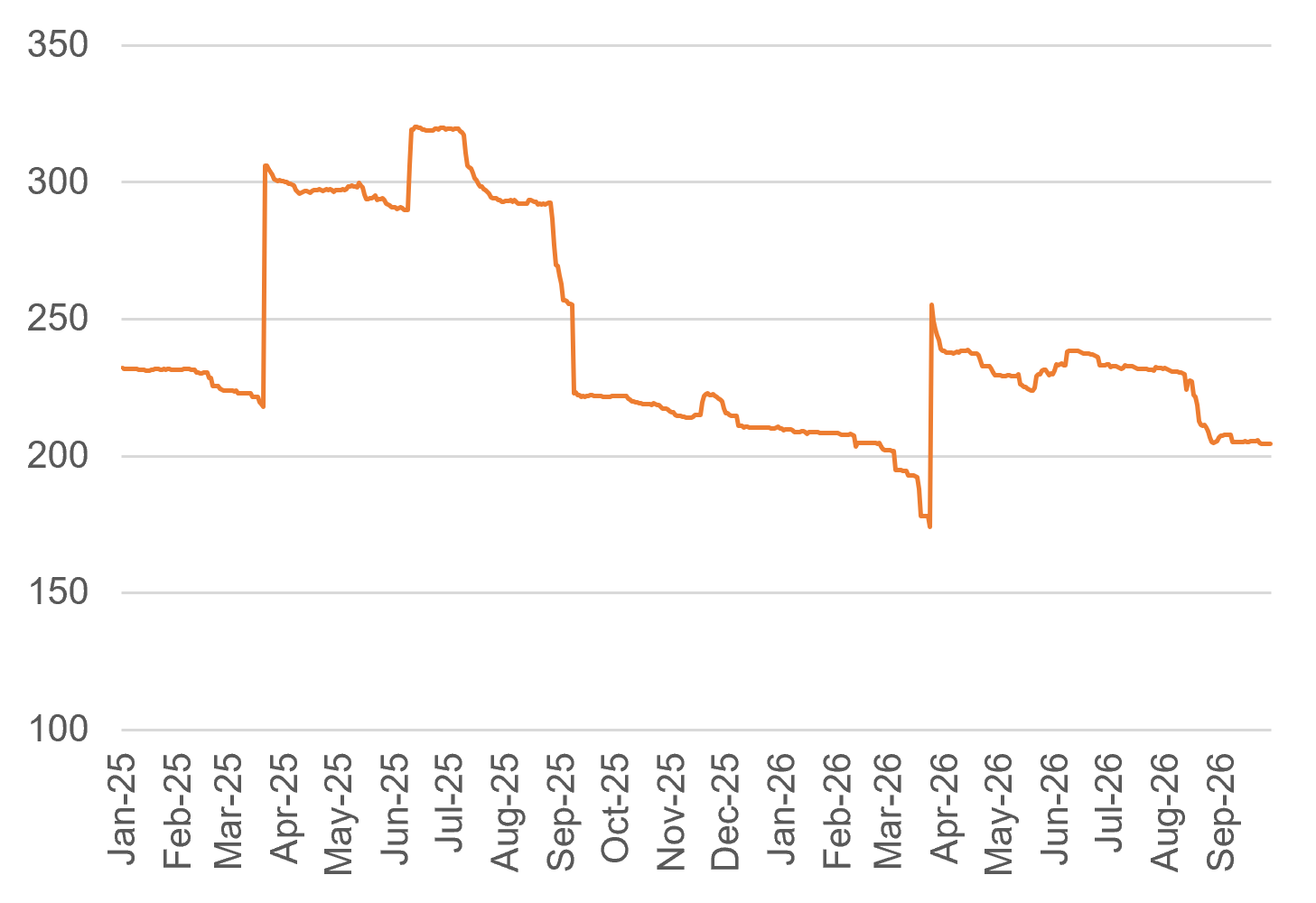
Source: Bloomberg, Sep 28, 2026.
The Capex and Profitability Mismatch
Although global tech giants are aggressively investing in AI infrastructure to ride the wave of the generative AI era, the Hong Kong internet sector finds itself trapped in a profound “expectations gap”: the market has shifted from rewarding long-term strategic imagination to rigorously scrutinizing the immediate returns on every capital expenditure (CapEx). However, facing this technological revolution, choosing not to invest is tantamount to giving up the future, while making heavy bets means enduring painful short-term financial distress. Because investments in large model training and computing infrastructure are massive, while commercialization paths are still being explored, it is extremely difficult to generate scaled profits in the near term. This reality of “heavy asset investment and light short-term return” not only highlights a strategic dilemma—where inaction means slow death, but action brings immediate pain—it also further suppresses the sector’s short-term earnings expectations and valuation performance.
| AI Capex Supercycle remains in Full Swing | Inference demand continues to grow |
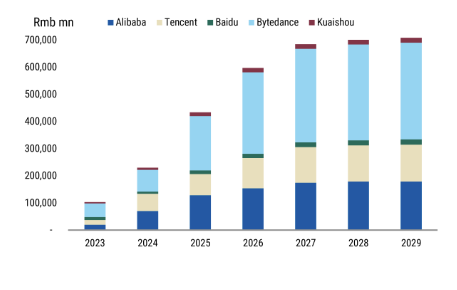 |
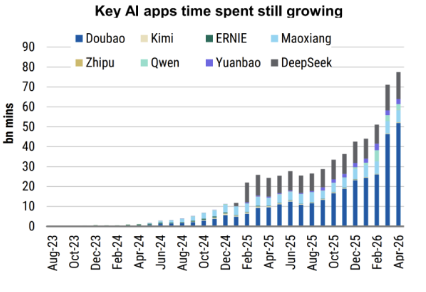 |
Source: Company Data, QuestMobile, Morgan Stanley Research estimates.
Offshore Sensitivity to Global Liquidity and FX
As a highly internationalized offshore financial market, the Hong Kong stock market is naturally sensitive to changes in global liquidity and geopolitical expectations, which manifests across overseas liquidity, capital preferences, and sentiment/FX dimensions. Specifically, the path of Federal Reserve monetary policy and high global risk-free interest rates suppress the discount value of long-term cash flows and pressure high-growth asset valuations; frequent adjustments by foreign allocation funds amid cross-market games deprive the offshore market of systematic long-term incremental capital inflows, thereby aggravating volatility; and lastly, exchange rate fluctuations alongside external geopolitical risk premiums weaken international investors’ risk appetite for Chinese assets.
In summary, the recent weakness in the Hang Seng TECH Index stems from the confluence of four core headwinds: a heavy consumer weighting facing sluggish domestic demand, the industry’s maturation and end of high growth, a mismatch between surging AI capital expenditures and short-term profit realization, and ongoing offshore liquidity disturbances.
Core Indicators to Watch:
- Domestic Demand & Consumption: High-frequency retail sales data, along with unit prices and profit margin recoveries for core local life and e-commerce enterprises.
- AI Commercialization Progress: Signs of substantive incremental revenue contributions from large-model businesses in financial reports.
- CapEx Discipline: The balance leading companies strike between aggressive AI investments and shareholder returns (buybacks and dividends).
Following a period of valuation reconstruction and near-term pain, the sector’s long-term investment appeal will ultimately anchor back to its true free cash flow generation and shareholder return capabilities. Investors are advised to maintain strategic composure while closely tracking fundamental turning points.
While the broader Hang Seng Tech Index faced a steep correction (-23.4%), the Global X Hang Seng TECH Covered Call Active ETF (3417 HK) demonstrated superior capital preservation—limiting its decline to just -7.8%—proving how an active option-writing overlay effectively cushions downside volatility while generating alternative income for investors targeting this benchmark.
Performance Comparison: 3417 HK vs HSTECH
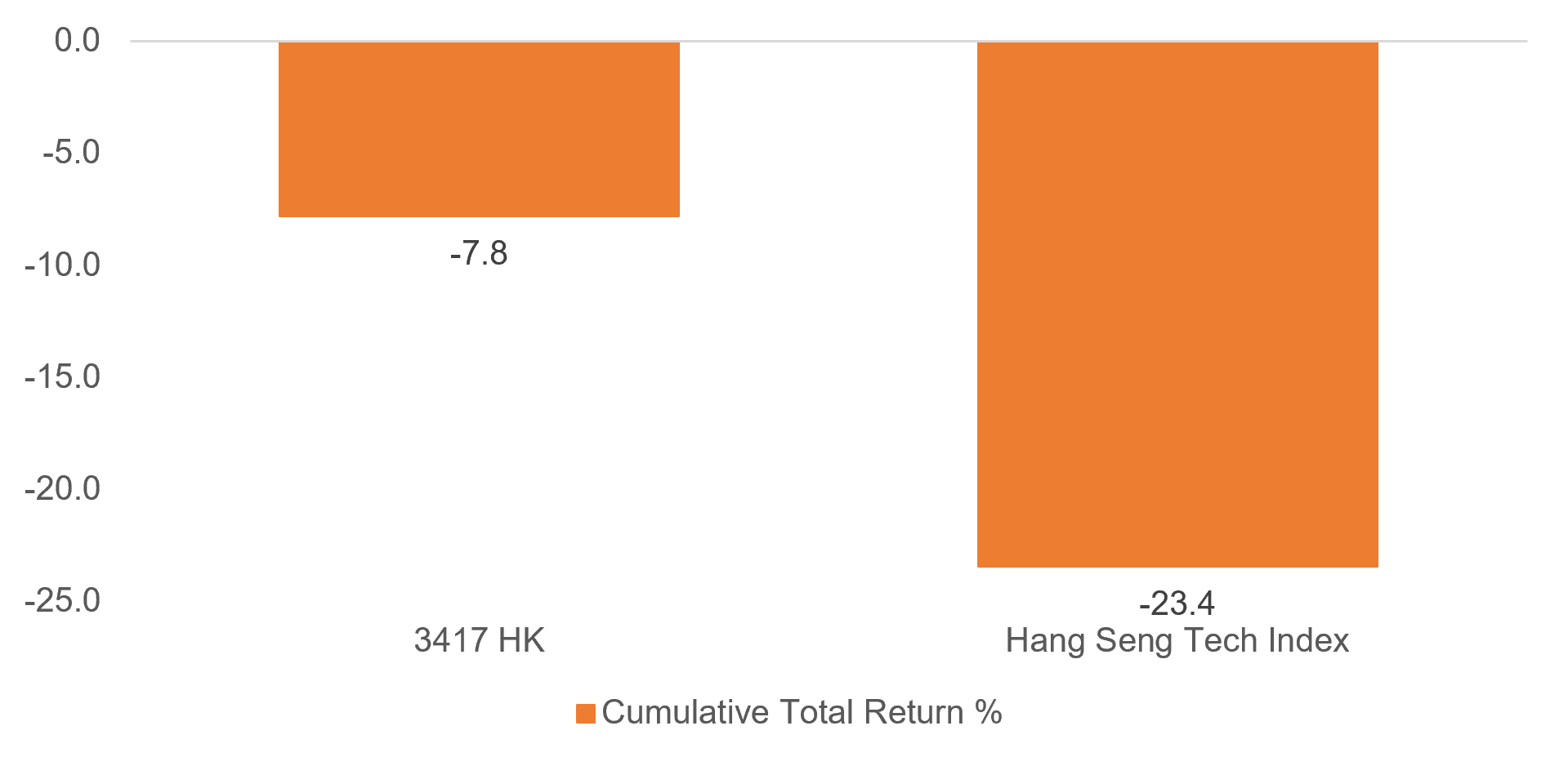
Source: Factset, Sep 28, 2026. The cumulative total return period is between Mar 13, 2025, and Sep 28, 2026. 3417 HK Fund inception date: 13 Mar 2025. Calendar year returns of the fund: 2025 (from first trading day): 5.7%; YTD 2026: -12.7%; Past 3M Performance: 0.2%.
Global X Hang Seng TECH ETF (2837 HK)
https://www.globalxetfs.com.hk/funds/hang-seng-tech-etf/
Global X Hang Seng TECH Covered Call Active ETF (3417 HK)
https://www.globalxetfs.com.hk/funds/hang-seng-tech-covered-call-active-etf/




 (852)3555 5888
 Leave Us A Note