Important Information
Investors should not base investment decisions on this website alone. Please refer to the Prospectus for details including the product features and the risk factors. Investment involves risks. Past performance is not indicative of future performance. There is no guarantee of the repayment of the principal. Investors should note:
- The investment objective of the Global X Copper Miners ETF (the “Fund”) is to provide investment results that, before fees and expenses, closely correspond to the performance of the Solactive Copper Miners Index (the “Index”).
- The Index is a new index and has minimal operating history by which investors can evaluate its previous performance. The Fund may be riskier than other exchange traded funds tracking more established indices with longer operating history.
- The Index constituents may be concentrated in copper ore mining and/or copper-derived structural shape manufacturing, which may potentially be more volatile than a fund with a diversified portfolio.
- The Fund may invest in small and/or mid-sized companies, which may have lower liquidity and their prices are more volatile to adverse economic developments.
- Investment in Emerging Market may involve increased risks and special considerations not typically associated with investments in more developed markets, such as liquidity risk, currency risks, political uncertainties, legal and taxation risks, and the likelihood of a high degree of volatility.
- The base currency of the Fund is USD but the trading currencies of the Fund are in HKD and USD. The NAV of the Fund and its performance may be affected by fluctuations in the exchange rates between these currencies and the base currency and by changes in exchange rate controls.
- The trading price of the Fund’s unit on the SEHK is driven by secondary market trading factors, which may lead to a substantial premium or discount to the Fund’s net asset value.
- The Manager may at its discretion pay dividends out of the capital of the Fund. Distributions paid out of capital, represent a return of an investor’s original investment or its gains and may potentially reduce the Fund’s Net Asset Value per Share as well as the capital available for future investment.
- The Fund may suffer from losses or delays when recovering the securities lent out. This may potentially affect its ability to meet payment and redemption obligations. Collateral shortfalls due to inaccurate pricing or change of value of securities lent, may cause significant losses to the Fund.
Why Invest in Copper Miners ETF?
Electric vehicles, AI, solar power, and power grid updates—behind almost every word used to describe the next big thing, there is copper. Naturally, the future demand for copper looks strong. According to the latest report from S&P Global, global copper demand is expected to grow by about 2.7% each year until 2040.
Honestly, looking at this growth rate by itself, it might not look very exciting.
However, what really makes copper a great investment is that, unlike other commodities, its supply is very tight while its demand is highly stable. These two points are crucial when investing in commodity asset class. Let us look at why investing in copper makes sense through these two crucial perspectives.
Global X Copper Miners ETF (3014 HK)
https://www.globalxetfs.com.hk/funds/copper-miners-etf/
[Figure1] Historical Copper Price Trend
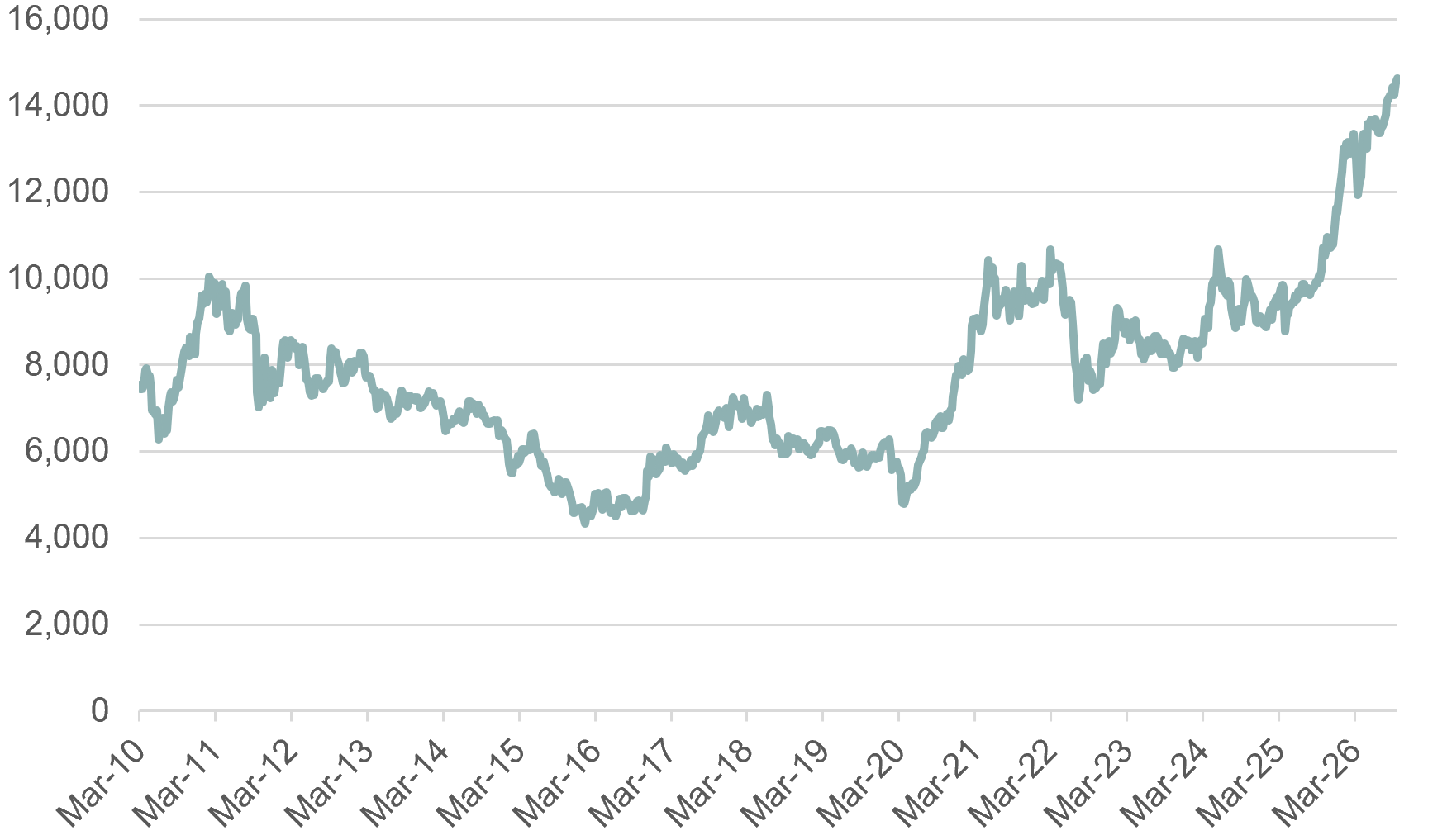
Source: LME, August 2026
First, copper supply is very tight, compared to other commodities.
Even if demand looks great, an investment loses its value if supply is bigger than demand.
Lithium is the very example of this. Just a few years ago, everyone called lithium the most important commodity for electric vehicles. People thought a supply shortage was guaranteed. Demand was indeed strong, growing by over 25% each year from 2020 to 2025. However, the real issue was supply. Mining companies developed lithium mines much faster than expected. Global lithium production jumped by nearly 29% each year over the last five years.
Why did lithium supply grow so fast? Every country has its own story, but the main reason is simple. Lithium only got attention 30 years ago from miners, when lithium batteries were first sold. Nobody cared about lithium during the Industrial Revolution of the 18th century and the electricity boom of the 19th century. Because of this short history, high-quality lithium mines are still common across the world. As a result, a brand-new lithium mine project only takes about 5 years to complete and start real production.
[Figure2] Comparison of Copper and Lithium from Supply Side
| Category | Copper | Lithium |
|---|---|---|
| Geological Mining Concentration |
|
|
| Completion Lead Times |
|
|
| Easiness to Start a Greenfield Project |
|
|
Source: Mirae Asset Global Investments (HK)
On the other hand, copper is totally different. Since the late 19th century, copper has been a key material for building modern industries. Miners have already found and used up the easy, high-quality copper mines over the last hundred years.
The main copper mines we use today are now getting too old. The older a mine gets, the lower the quality of the copper rock becomes, and the deeper companies must dig. If a company wants to build a brand-new, large copper mine, it takes an average of 15 years from the first dig to actual production.
For this reason, S&P Global, a leading forecaster, projects that global copper supply will only grow by about 2.3% each year till 2040. This slow growth rate means the market will face a 10 million metric ton shortfall by 2040, leaving supply 24% short of demand. This is lower than the 2.7% demand growth rate we talked about earlier, which will likely push copper prices up.
[Figure 3] Long Term Copper Demand and Supply Balance Forecast
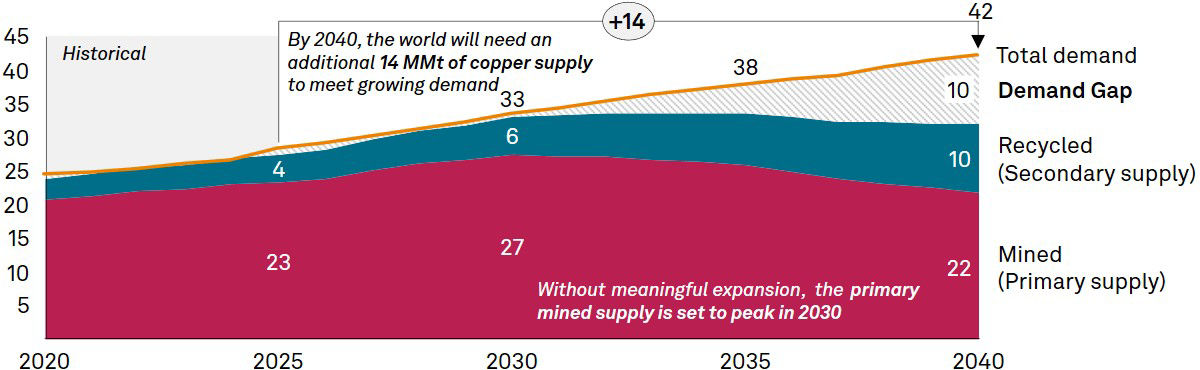
Source: S&P Global forecast, 2026
Second, compared to other commodities, copper demand is growing reliably and steadily.
Regarding demand, most other commodities tend to face stagnant demand or unpredictable volatility. To start, many commodities have very low growth expectations. For example, crude oil demand is expected to grow by less than 1% p.a. over the next ten years, due to the accelerating penetration of EVs (forecast by IEA).
Global iron ore demand is also expected to stall, growing by a mere 0.2% each year over the next decade. The massive investment boom in Chinese real estate is over, and the market cannot find a new buyer to replace the Chinese real estate market, which used to make up a staggering 25% of the total global iron ore demand.
In contrast, copper demand is set to grow naturally due to its unique structure. First, this is thanks to the steady rise of EVs. An EV uses about four times more copper than a conventional gas-powered car. Second, the rising share of clean energy in the global power mix structurally drives copper demand. Power grid investment alone accounts for roughly 30% of global copper demand while the Chinese real estate market makes up only about 5% of the global copper market. Indeed, another attractive feature of copper is that its demand is well-diversified across different sectors.
[Figure 4] Copper Demand Breakdown by Vehicle Type
| Category | ICE Vehicle | EV |
|---|---|---|
| Battery | ~1 kg (12V starter) |
25-30 kg |
| Electric Motor / Inverter | 0 kg | 20-25 kg |
| High-Voltage Wiring | 0 kg | 15-20 kg |
| Low-Voltage Harness | 18-22 kg | 18-22 kg |
| Onboard Charger / DC-DC | ~1 kg | 2-4 kg |
| Total> | 20-25 kg> | 80-85 kg> |
Source: IEA, ICA, S&P Global Commodity Insights
One might ask: aren’t there other raw materials tied to this electrification trend, like cobalt and nickel?
Just a decade ago, cobalt and nickel were the focus of excitement. Today, however, the market mood has completely changed. Battery manufacturers are dropping expensive cobalt and nickel by switching to cheaper lithium iron phosphate (LFP) batteries. This shift has slowed down the demand for high-nickel batteries that once ruled the market.
What if copper prices spike aggressively and copper is replaced by other commodities? Companies and users may look for alternatives like aluminium. However, aluminium has lower electrical conductivity than copper. It cannot replace copper in high-voltage, high-density use cases. While metals like silver offer better conductivity, they are far too expensive to compete with copper on a large scale.
In conclusion, because of these two attributes of supply tightness and stable demand, copper stands out as the most compelling commodity to watch as an investment.
So, how should you invest?
You can look at the Global X Copper Miners ETF (3014 HK), which invests in global leading copper mining companies. This product lets you invest in the potential for a long-term, structural rise in copper prices. When copper prices go up, a mining company’s selling price typically rises straight away. However, their costs like labour, equipment, and energy may not move by the same amount in the short term. This creates operating leverage that may significantly multiply the company’s earnings. However, this leverage can also work in the opposite direction, and earnings may fall materially if copper prices decline.
[Figure5] Top 10 holdings of Copper Miners ETF
| Name | Ticker | Weight (%) |
|---|---|---|
| FIRST QUANTUM MINERALS | FM CN | 7.91 |
| SOUTHERN COPPER CORP | SCCO US | 7.82 |
| FREEPORT-MCMORAN | FCX US | 7.78 |
| HUDBAY MINERALS | HBM CN | 7.65 |
| TECK RESOURCES | TECK/B CN | 7.47 |
| GRUPO MEXICO SAB DE CV | GMEXICOB MM | 7.35 |
| KGHM POLSKA MIEDZ | KGH PW | 6.91 |
| ANTOFAGASTA | ANTO LN | 6.75 |
| LUNDIN MINING | LUN CN | 6.68 |
| MUELLER INDUSTRIES | MLI US | 6.52 |
Source: Mirae Asset Global Investments (HK), 28 Sept, 2026



 (852)3555 5888
 Leave Us A Note