Important Information
Investors should not base investment decisions on this material alone. Please refer to the Prospectus for details including the product features and the risk factors. Investment involves risks. Past performance is not indicative of future performance. There is no guarantee of the repayment of the principal. Investors should note:
- The investment objective of Global X Hang Seng High Dividend Yield ETF (the “Fund”) is to provide investment results that, before deduction of fees and expenses, closely correspond to the performance of the Hang Seng High Dividend Yield Index.
- Whether or not distributions will be made by the Fund is at the discretion of the Manager taking into account various factors and its own distribution policy. There can be no assurance that the distribution yield of the Fund is the same as that of the Index.
- The Fund may invest in mid-sized companies, which may have lower liquidity and their prices are more volatile to adverse economic developments.
- The Fund invests in the emerging markets which may involve increased risks and special considerations not typically associated with investment in more developed markets, such as liquidity risks, currency risks/control, political and economic uncertainties, legal and taxation risks, settlement risks, custody risk and the likelihood of a high degree of volatility.
- The trading price of the Fund’s unit on the SEHK is driven by secondary market trading factors, which may lead to a substantial premium or discount to the Fund’s net asset value.
- The Manager may at its discretion pay dividends out of the capital of the Fund. Distributions paid out of capital, represent a return of an investor’s original investment or its gains and may potentially reduce the Fund’s Net Asset Value per Share as well as the capital available for future investment.
- The Fund may suffer from a losses or delays when recovering the securities lent out. This may potentially affect its ability to meet payment and redemption obligations. Collateral shortfalls due to inaccurate pricing or change of value of securities lent, may cause significant losses to the Fund.
- The investment objective of Global X Hang Seng High Dividend Yield Enhanced Income ETF (the “Fund”) is to achieve income and long-term capital appreciation by (i) investing in constituent equity securities in the Hang Seng High Dividend Yield Index (the “Reference Index”) and/or units of the Global X Hang Seng High Dividend Yield ETF (the “Reference ETF”) and (ii) selling (i.e. “writing”) call options on the Hang Seng Index and/or Hang Seng China Enterprises Index (“HSI/HSCEI”) to receive payments of money from the purchaser of call options (i.e. “premium”).
- The Fund employs an actively managed investment strategy. The Fund may fail to meet its objective as a result of the implementation of investment process which may cause the Fund to underperform as compared to direct investments in the constituent equity securities of the Reference Index.
- The Fund invests substantially in the Reference ETF, and it may also be subject to the risks associated with the Reference ETF’s investments.
- The Fund’s ability to utilise Reference Index Call Options successfully will depend on the ability of the Manager to correctly predict future price fluctuations. If a Reference Index Call Option expires and if the Reference Index declines during the option period, the premiums received may not be sufficient to offset the loss realised.
- The use of futures contracts involves market risk, volatility risk, leverage risk and negative roll yields and “contango” risk.
- Investing in Reference Index Futures and writing Reference Index Call Options generally involve the posting of margin. If the Fund is unable to meet its investment objective as a result of margin requirements imposed by the HKFE, the SEHK and/or the Fund’s broker, the Fund may experience significant losses.
- To the extent that the constituent securities of Reference Index are concentrated in securities of a particular sector or market, the investments of it may be similarly concentrated.
- The Fund may suffer from losses or delays when recovering the securities lent out. This may potentially affect its ability to meet payment and redemption obligations. Collateral shortfalls due to inaccurate pricing or change of value of securities lent, may cause significant losses to the Fund.
- The Manager may at its discretion pay dividends out of the capital of the Fund. Distributions paid out of capital, represent a return of an investor’s original investment or its gains and may potentially reduce the Fund’s Net Asset Value per Share as well as the capital available for future investment.
- The ETFs in which the Fund may invest may be managed by the Manager or its Connected Persons, and potential conflicts of interest may arise.
- The trading price of the Fund’s unit on the SEHK is driven by secondary market trading factors, which may lead to a substantial premium or discount to the Fund’s net asset value.
- The investment objective of Global X Gold Covered Call Active ETF (the “Fund”)* (*This is a synthetic ETF) is to generate income by primarily providing exposure to gold futures and/or exchange traded funds tracking the price of gold (collectively, the “Gold Performance”) with a covered call strategy. The Fund will use a synthetic investment strategy by investing up to 100% of its Net Asset Value in fully funded total return swaps.
- This synthetic investment strategy exposes the Fund to counterparty risk including under collateralisation risk, default risk, intra-day counterparty risk, early termination of swaps risk and change of swap fees risk.
- The Fund invests more than 50% and up to 100% of its Net Asset Value in FDIs. Associated risks include counterparty/credit risk, liquidity risk, valuation risk, volatility risk and over-the-counter transaction risk.
- The Fund employs an actively managed investment strategy. The Fund may fail to meet its objective as a result of the implementation of investment process which may cause the Fund to underperform as compared to direct investments in the constituent equity securities of the Reference Index.
- The Fund’s opportunity to benefit from the increases in the Gold Performance will be limited the strike price of the referenced Gold Call Options plus the notional premium. In rapidly rising markets, this limitation may result in the Fund underperforming the Gold Performance. Conversely, the Fund remains exposed to declines in the Gold Performance, as the covered call strategy embedded in the swap does not provide full downside protection.
- If the fund is unable to obtain sufficient exposure to Gold Performance due to the limited availability of swaps, the Fund may suspend creations, which could cause the Fund to trade at a significant premium or discount.
- The investments of the Sub-Fund are concentrated in the performance of gold generally and will result in large concentration risk.
- Potential conflicts of interest may arise as the Manager and one of the Swap Counterparties are members of the same group.
- The markets on which the gold futures, Gold ETFs and listed Gold Call Options are traded and the SEHK may have different trading hours. The Fund’s value may change on days when investors will not be able to purchase or sell the Fund’s Shares.
- The trading price of the Fund’s unit on the SEHK is driven by secondary market trading factors, which may lead to a substantial premium or discount to the Fund’s net asset value.
- The Fund may be terminated early under certain circumstances (e.g., if NAV falls below HK$50 million), which could result in a loss of investment.
- The Manager may at its discretion pay dividends out of the capital of the Fund. Distributions paid out of capital, represent a return of an investor’s original investment or its gains and may potentially reduce the Fund’s Net Asset Value per Share as well as the capital available for future investment.
Hedging USD: West Germany 1974 and China 2026
If we were to summarize signals from the US bond market into a single point, it is the “potential weakness of the US dollar”.
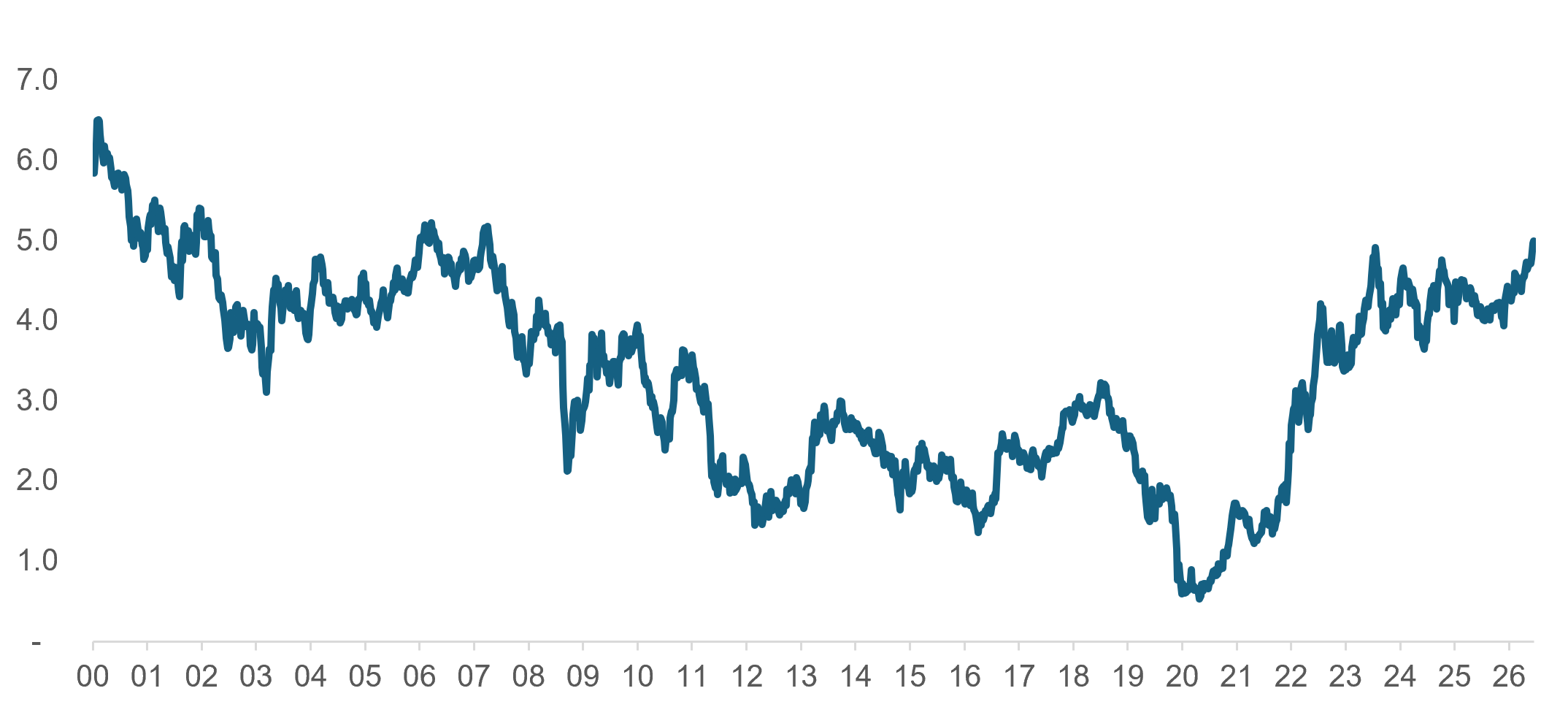
The US 10-year government yield has recently spiked to 5%. This surge is not merely a reflection of inflationary pressures. It is a direct warning from the market that the federal debt load has grown unsustainable.
[Figure 1] The US 10-year government bond yield
(Source) Bloomberg, 21 September 2026
Thus, the US government is likely to allow high inflation to run unchecked as an “inflation tax“—effectively the only viable escape for its mountain of debt.
US Needs an Old Playbook
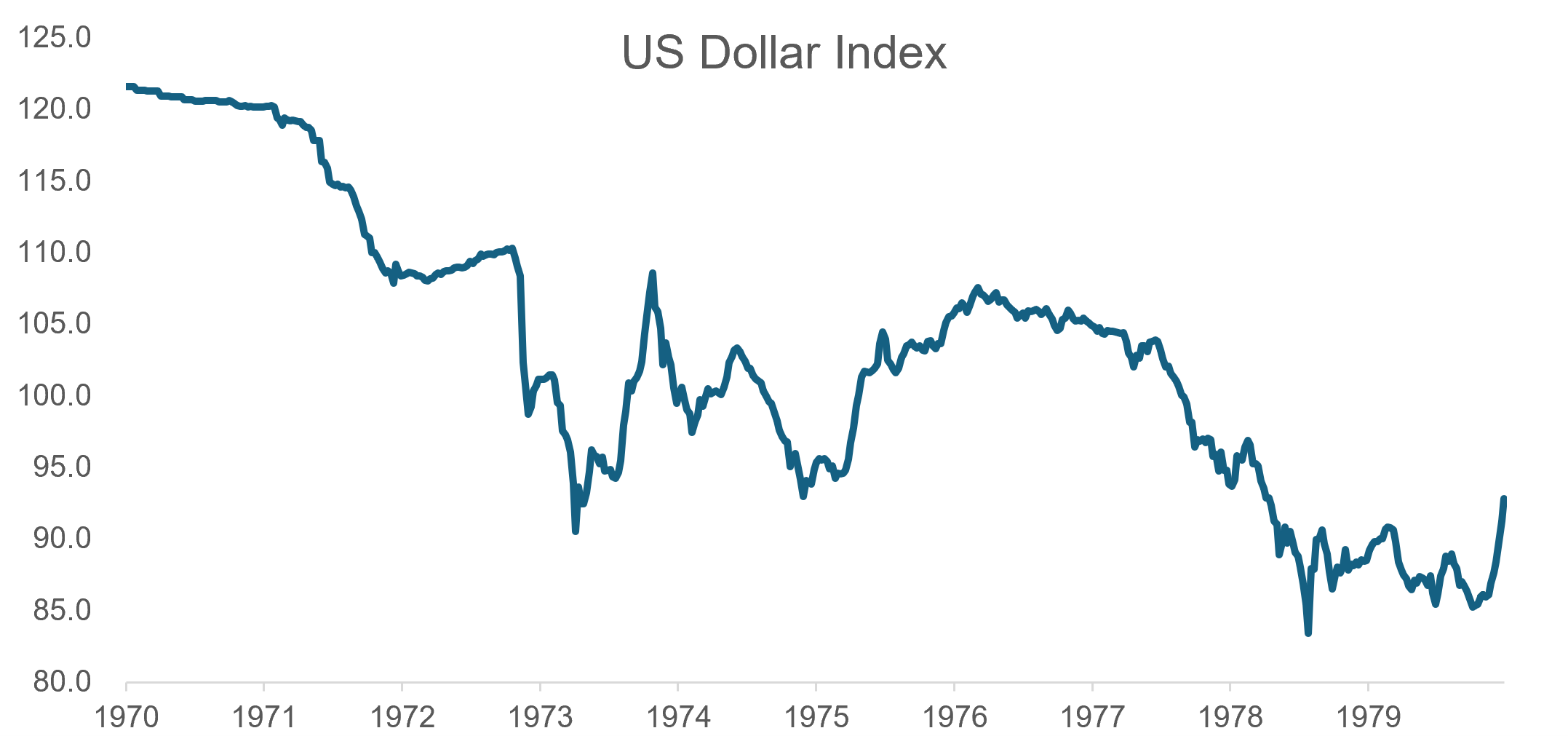
This is a playbook the US used in the 1970s, a period when interest rates were largely kept lower than inflation rates. As a result, the US Dollar Index fell from the 120 range from early 1970s to the 80 range by the end of the decade. The devaluation was even more stark against the West German Deutsche Mark, falling from 3.6 marks per dollar in 1971 to 1.7 marks in 1979—over 50%.
While Paul Volcker’s appointment as the US Fed Chair in 1979 revived the dollar by pushing interest rates up to 20%, he had a luxury that today’s policymakers lack: a light debt burden.
In the 1970s, US government debt averaged 30% of GDP, and the annual deficit was 2%. Today, the debt-to-GDP ratio towers above 120%, and the annual deficit tracks at 6% of GDP, severely limiting how far the Fed can push rates without triggering a debt payment crisis.
In other words, there is a growing likelihood that interest rates will remain below inflation moving forward—a dynamic that is poised to weaken the US dollar.
[Figure 2] US Dollar Index in the 1970s
(Source) Bloomberg
In such a scenario, what are the viable investment alternatives?
Alternatives to USD Asset (1): Gold + Covered Call Strategy
First, as universally acknowledged, holding gold serves as an effective macroeconomic hedge. However, gold has an inherent drawback: it yields neither dividends nor interest income. To bridge this gap, Global X has introduced a gold-based covered call strategy, which overlays an income-generating strategy onto gold asset, Global X Gold Covered Call Active ETF (3533 HK) * (*This is a synthetic ETF).
The fund has demonstrated an average monthly distribution yield of more than 1% over its first three months since the launch in 2026(Distribution rate is not guaranteed. Distribution may be made out of capital 1). Investors must note, however, the trade-off: this strategy caps potential capital appreciation during sharp gold price rallies, a constraint embedded within any covered call strategy.
Alternatives to USD Asset (2): RMB + Dividend Strategy
The second alternative is allocating to RMB-denominated assets. We anticipate that the RMB is highly likely to strengthen over the next few years for two primary reasons:
First, in our view, currency adjustment is effectively the only remaining mechanism to resolve the global trade imbalance between China and the rest of the world. China’s manufacturing competitiveness has grown so dominant that it can no longer be counterbalanced without currency revaluation. According to the IMF, the Chinese currency is undervalued by 10%–15%, while Goldman Sachs places this undervaluation even higher, at 20%–25%.
Up to this point, the US has attempted to counter China through tariffs and sanctions. However, these measures have largely fallen short. China’s trade surplus expanded to $1.2 trillion in 2025 and exports to the US have even accelerated in recent months. Consequently, we believe the US will have no choice but to revert to historical playbook, using currency adjustment to correct its trade deficit.
In this regard, West Germany in the 1970s and present-day China share a resemblance: both standout as dominant manufacturing powerhouses running massive trade surpluses.
Second, among major economies, China is uniquely focused on fiscal discipline. The escalating sovereign debt crisis plagues among most developed nations like France, UK, and Japan. 10-year government bond yields across the UK, France, and Japan also have surged this year, moving in lockstep with US Treasuries. China is certainly not immune to debt problem, particularly with local government debt (LGFV) issues. However, unlike the US, over the past several years, Beijing has executed a painful de-risking campaign.
Admittedly, the primary drawback of allocating to RMB assets is China’s low yield environment. The Chinese 10-year government bond yield has declined to 1.7% in Sep 2026, widening the yield gap against US Treasuries to roughly 3.3 percentage points.
Fortunately, Global X provides a sophisticated workaround to this limitation. We highlight the Global X Hang Seng High Dividend Yield Enhanced Income ETF (3555 HK) as the premier vehicle for this strategy.
First, China currently offers an ideal macro backdrop for dividend-centric investing. While the property market headwinds persist, China’s dominant manufacturing competitiveness provides a resilient economic anchor.
This economic resilience supports robust equity dividends, as exemplified by the Global X Hang Seng High Dividend Yield ETF (3110 HK), which has historically delivered an annualized dividend yield of around 6% (Distribution rate is not guaranteed. Distribution may be made out of capital 2). Nevertheless, standalone high-dividend equities remain vulnerable to stock market volatility and potential capital drawdowns.
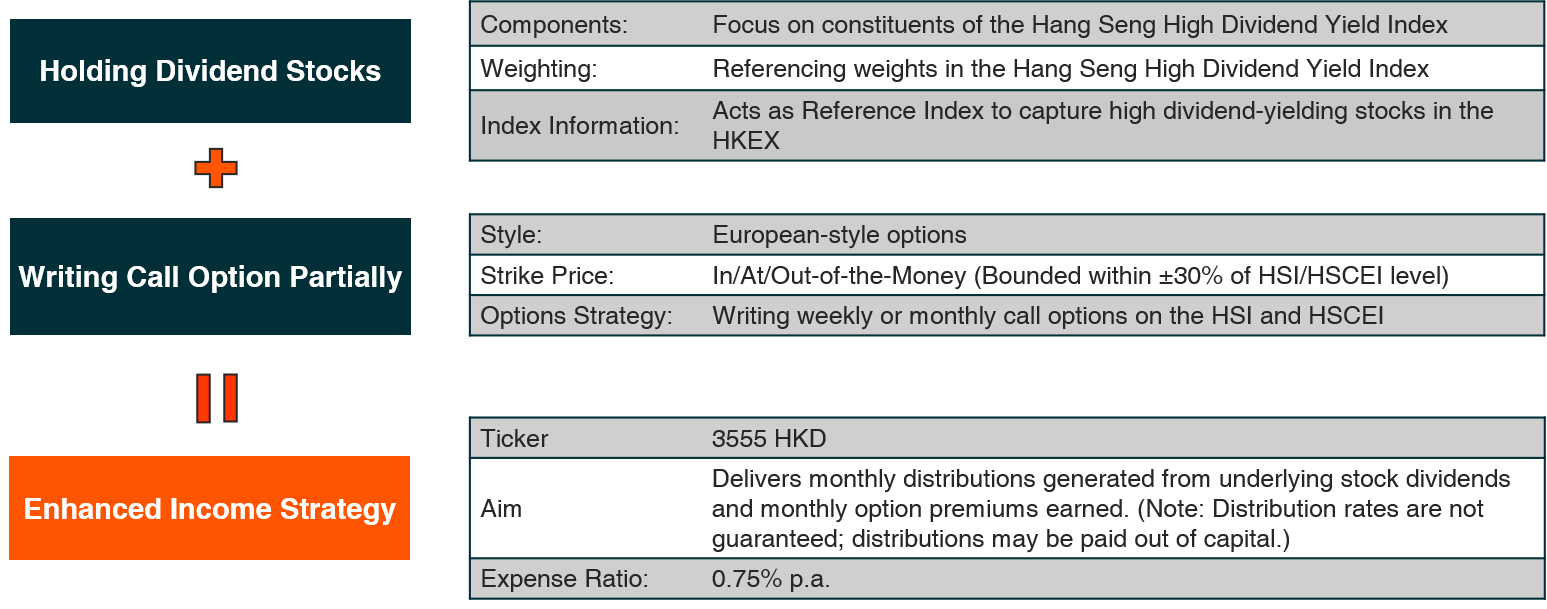
To mitigate drawdown risk, 3555 HK implements a partial covered call option strategy that holds high-dividend equities while systematically writing call options on the benchmark index to cover 30% to 50% of the exposure. This tactical overlay provides a robust downside cushion.
[Figure 3] Investment scheme of 3555 HK





 (852)3555 5888
 Leave Us A Note