Important Information
Investors should not base investment decisions on this material alone. Please refer to the Prospectus for details including the product features and the risk factors. Investment involves risks. Past performance is not indicative of future performance. There is no guarantee of the repayment of the principal. Investors should note:
- The investment objective of Global X China Electric Vehicle and Battery ETF’s (the “Fund”) is to provide investment results that, before fees and expenses, closely correspond to the performance of the Solactive China Electric Vehicle and Battery Index.
- The Fund is exposed to concentration risk by tracking a single region or country.
- The Index constituents may be concentrated in a specific industry or sector, which may potentially more volatile than a fund with a diversified portfolio.
- Investment in Emerging Market, such as A-share market, may involve increased risks and special considerations not typically associated with investments in more developed markets, such as liquidity risk, currency risks, political risk, legal and taxation risks, and the likelihood of a high degree of volatility.
- The Stock Connect is subject to quota limitations. Where a suspension in the trading through the Stock Connect is effected, the Sub-Fund’s ability to invest in A-Shares or access Mainland China markets through the programme will be adversely affected.
- Listed companies on the ChiNext market and/or STAR Board are usually subject to higher fluctuation in stock prices and liquidity risks, over-valuation risk, differences in regulation, delisting risk, and concentration risk.
- There are risks and uncertainties associated with the current Mainland China tax laws, regulations and practice in respect of capital gains realized via Stock Connect on the Fund’s investments in Mainland China. Any increased tax liabilities on the Fund may adversely affect the Fund’s value.
- The trading price of the Fund’s unit on the SEHK is driven by secondary market trading factors, which may lead to a substantial premium or discount to the Fund’s net asset value.
- The Fund’s synthetic replication strategy may invest up to 50% of its net asset value in financial derivative instruments (“FDIs”), which may expose the Fund to counterparty/credit risk, liquidity risk, valuation risk, volatility risk and over-the-counter transaction risk. The Fund may suffer losses from its usage of FDIs.
- The Manager may at its discretion pay dividends out of the capital of the Fund. Distributions paid out of capital, represent a return of an investor’s original investment or its gains and may potentially reduce the Fund’s Net Asset Value per Share as well as the capital available for future investment.
- The Fund may suffer from a losses or delays when recovering the securities lent out. This may potentially affect its ability to meet payment and redemption obligations. Collateral shortfalls due to inaccurate pricing or change of value of securities lent, may cause significant losses to the Fund.
- The investment objective of Global X China Clean Energy ETF (the “Fund”) is to provide investment results that, before fees and expenses, closely correspond to the performance of the Solactive China Clean Energy Index.
- The Fund is exposed to concentration risk by tracking a single region or country.
- The Index constituents may be concentrated in a specific industry or sector, which may potentially more volatile than a fund with a diversified portfolio.
- Investment in Emerging Market, such as A-share market, may involve increased risks and special considerations not typically associated with investments in more developed markets, such as liquidity risk, currency risks, political risk, legal and taxation risks, and the likelihood of a high degree of volatility.
- The Stock Connect is subject to quota limitations. Where a suspension in the trading through the Stock Connect is effected, the Sub-Fund’s ability to invest in A-Shares or access Mainland China markets through the programme will be adversely affected.
- Listed companies on the ChiNext market and/or STAR Board are usually subject to higher fluctuation in stock prices and liquidity risks, over-valuation risk, differences in regulation, delisting risk, and concentration risk.
- There are risks and uncertainties associated with the current Mainland China tax laws, regulations and practice in respect of capital gains realized via Stock Connect on the Fund’s investments in Mainland China. Any increased tax liabilities on the Fund may adversely affect the Fund’s value.
- The trading price of the Fund’s unit on the SEHK is driven by secondary market trading factors, which may lead to a substantial premium or discount to the Fund’s net asset value.
- The Fund’s synthetic replication strategy may invest up to 50% of its net asset value in financial derivative instruments (“FDIs”), which may expose the Fund to counterparty/credit risk, liquidity risk, valuation risk, volatility risk and over-the-counter transaction risk. The Fund may suffer losses from its usage of FDIs.
- The Manager may at its discretion pay dividends out of the capital of the Fund. Distributions paid out of capital, represent a return of an investor’s original investment or its gains and may potentially reduce the Fund’s Net Asset Value per Share as well as the capital available for future investment.
- The Fund may suffer from a losses or delays when recovering the securities lent out. This may potentially affect its ability to meet payment and redemption obligations. Collateral shortfalls due to inaccurate pricing or change of value of securities lent, may cause significant losses to the Fund.
- The investment objective of Global X S&P Crude Oil Futures Enhanced ER ETF (the “Fund”) is to provide investment results that, before deduction of fees and expenses, closely correspond to the performance of the S&P GSCI Crude Oil Enhanced Index Excess Return.
- As the exposure of the Fund is concentrated in the crude oil market, it is more susceptible to the effects of crude oil price volatility than more diversified funds.
- Crude oil prices are highly volatile and may fluctuate widely and may be affected by numerous events or factors such as crude oil production and sale, complex interaction of supply and demand of crude oil, weather, crude oil inventory level, war, speculator’s activities, Organization of the Petroleum Exporting Countries’ behaviour andcontrol, economic activity of significant crude oil use country and other financial market factors.
- The exposure of the Fund is concentrated in the crude oil market, it is more susceptible to the effects of crude oil price volatility than more diversified funds.
- Investment in futures contracts involves specific risks such as high volatility, leverage, rollover and margin risks.
- The trading price of the Fund’s unit on the SEHK is driven by secondary market trading factors, which may lead to a substantial premium or discount to the Fund’s net asset value.
The New Reality for Oil Price and Relevant ETFs
Predicting what will happen next in the Middle East is no easy task. However, one thing has become increasingly clear: even if the conflict comes to a swift end, oil prices are unlikely to see a significant decline — and there are several reasons behind this.
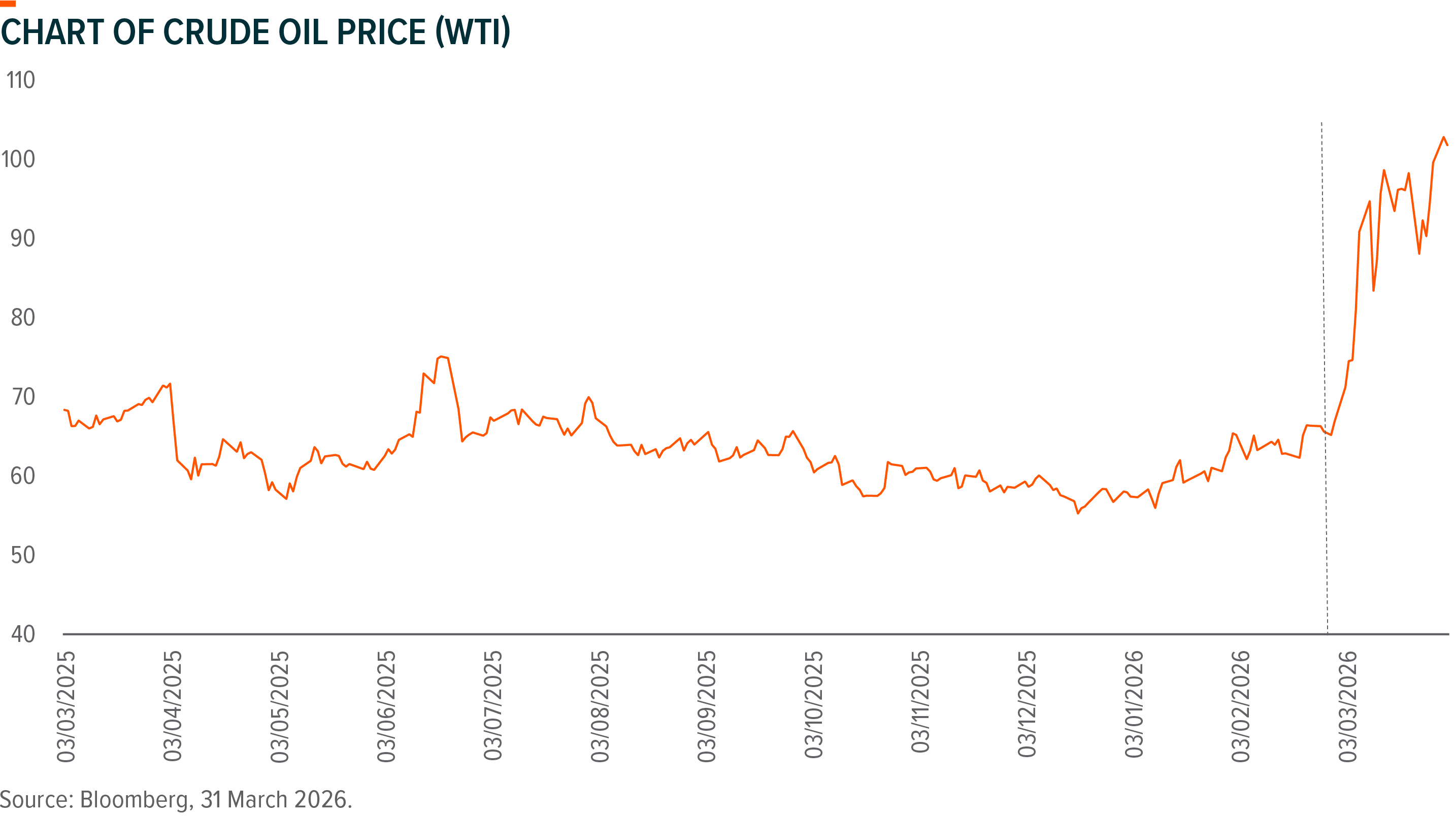
First, the main reason is the massive damage to energy infrastructure. In the last month alone, facilities that process 5~6 million barrels of oil per day have been hit. To put that in perspective, the entire world only uses about 105 million barrels a day. Losing that much supply is a blow that cannot be fixed quickly.
- Oil production/export Facilities: relatively easier to fix
Approximately 3~4 million bpd (barrels per day) of production/export disruption. Iran’s Kharg Island terminal suffered serious obliteration from airstrikes. Fortunately, these oil facilities are relatively easier to repair.
- Refinery Facilities: where the real problem lies:
Approximately 5~6 million bpd of refining capacity has been wiped out. Critical assets—such as the cooling lines at Qatar’s Ras Laffan LNG complex, the Atmospheric Distillation Units (CDU) at Saudi’s Ras Tanura, and the control systems at Kuwait’s Mina Al-Ahmadi—were targeted. These are high-tech installations containing various complicated precision components. Full restoration are expected to take 3~5 years.
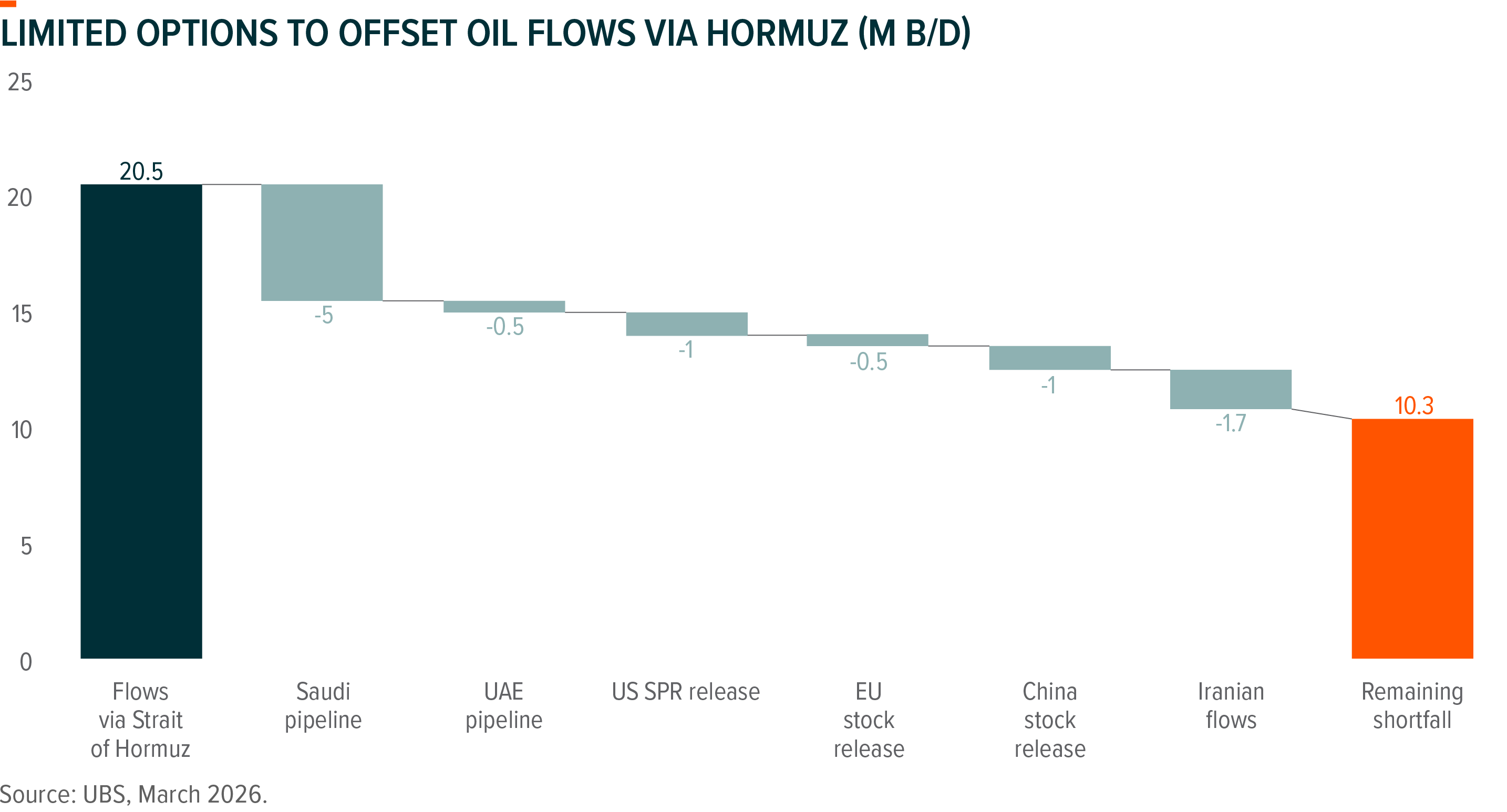
Second, the nature of the conflict has shifted. As The Economist noted in the latest issue, we are now seeing two parallel wars:
- The Military War: The US and Israeli campaign against the Iranian regime
- The Economic War: Iran’s strikes on the global energy
Iran has identified a key American weakness: the political and economic pain of rising oil prices. Because sprawling energy hubs in GCC countries are so difficult to defend, they remain highly vulnerable to ongoing attacks.
Global X ETFs for the New Energy Environment
In these circumstances, we’d like to propose three Global X products positioned to help investors navigate the volatility ahead.
| Ticker | Fund Name | Investment Point |
|---|---|---|
| 3097 | Global X S&P Crude Oil Futures Enhanced ER ETF | Likelihood of high oil prices persisting for an extended period. |
| 2809 | Global X China Clean Energy ETF | With Qatar’s Ras Laffan LNG facilities taking 3-5 years to fully recover, the world is facing a massive electric power baseload gap. |
| 2845 | Global X China Electric Vehicle and Battery ETF | While many focus on crude oil, the destruction of 5-6 million bpd of refining capacity means gasonline and diesel price may stay 2x higher than per-war levels |
Global X S&P Crude Oil Futures Enhanced ER ETF (3097)
- It acts as a direct beneficiary of oil supply disruptions in the Middle East, such as the blockade of the Strait of Hormuz or the destruction of Iranian/GCC export terminals.
- Since it invests in futures rather than energy company stocks, investors can focus purely on the price movement of the oil asset class without exposure to individual corporate management risks or stock market volatility.
- It tracks the performance of West Texas Intermediate (WTI) Crude Oil by investing directly in WTI crude oil futures contracts.
- https://www.globalxetfs.com.hk/funds/sp-crude-oil-futures-etf/
Global X China Clean Energy ETF (2809)
- With Qatar’s Ras Laffan LNG facilities (~20% destroyed) taking 3-5 years to fully recover, the world is facing a massive electric power baseload gap. This is driving an emergency acceleration into utility-scale solar/wind/nuclear and ESS projects. Chinese firms in this ETF are the key companies with the manufacturing scale to deliver these project
- Every major economy is now pivoting to solar and wind as “self-generated energy.” As China controls 80%+ of the solar supply chain, this ETF is effectively a bet on global “Energy Independence” infrastructure.
- https://www.globalxetfs.com.hk/funds/china-clean-energy-etf/
Global X China Electric Vehicle and Battery ETF (2845)
- Higher refining cost: While many focuses on crude oil, the destruction of 5-6 million bpd of refining capacity (Ras Tanura, Mina Al-Ahmadi, etc.) means gasoline and diesel prices may stay 2x higher than pre-war levels.
- Competitiveness vs global auto peers: The 2026 oil crisis has spiked shipping and energy costs globally. However, China’s EV and battery giants operate within a highly integrated domestic ecosystem. They are also less vulnerable to the “energy-inflation” hitting Western automakers, who are seeing their production costs soar due to European and American energy price spikes.
- https://www.globalxetfs.com.hk/funds/china-electric-vehicle-etf/






 (852)3555 5888
 Leave Us A Note