Important Information
Investors should not base investment decisions on this material alone. Please refer to the Prospectus for details including the product features and the risk factors. Investment involves risks. Past performance is not indicative of future performance. There is no guarantee of the repayment of the principal. Investors should note:
- The investment objective of Global X Gold Covered Call Active ETF (the “Fund”)* (*This is a synthetic ETF) is to generate income by primarily providing exposure to gold futures and/or exchange traded funds tracking the price of gold (collectively, the “Gold Performance”) with a covered call strategy. The Fund will use a synthetic investment strategy by investing up to 100% of its Net Asset Value in fully funded total return swaps.
- This synthetic investment strategy exposes the Fund to counterparty risk including under collateralisation risk, default risk, intra-day counterparty risk, early termination of swaps risk and change of swap fees risk.
- The Fund invests more than 50% and up to 100% of its Net Asset Value in FDIs. Associated risks include counterparty/credit risk, liquidity risk, valuation risk, volatility risk and over-the-counter transaction risk.
- The Fund employs an actively managed investment strategy. The Fund may fail to meet its objective as a result of the implementation of investment process which may cause the Fund to underperform as compared to direct investments in the constituent equity securities of the Reference Index.
- The Fund’s opportunity to benefit from the increases in the Gold Performance will be limited the strike price of the referenced Gold Call Options plus the notional premium. In rapidly rising markets, this limitation may result in the Fund underperforming the Gold Performance. Conversely, the Fund remains exposed to declines in the Gold Performance, as the covered call strategy embedded in the swap does not provide full downside protection.
- If the fund is unable to obtain sufficient exposure to Gold Performance due to the limited availability of swaps, the Fund may suspend creations, which could cause the Fund to trade at a significant premium or discount.
- The investments of the Sub-Fund are concentrated in the performance of gold generally and will result in large concentration risk.
- Potential conflicts of interest may arise as the Manager and one of the Swap Counterparties are members of the same group.
- The markets on which the gold futures, Gold ETFs and listed Gold Call Options are traded and the SEHK may have different trading hours. The Fund’s value may change on days when investors will not be able to purchase or sell the Fund’s Shares.
- The trading price of the Fund’s unit on the SEHK is driven by secondary market trading factors, which may lead to a substantial premium or discount to the Fund’s net asset value.
- The Fund may be terminated early under certain circumstances (e.g., if NAV falls below HK$50 million), which could result in a loss of investment.
- The Manager may at its discretion pay dividends out of the capital of the Fund. Distributions paid out of capital, represent a return of an investor’s original investment or its gains and may potentially reduce the Fund’s Net Asset Value per Share as well as the capital available for future investment.
Gold ETF or Gold Covered Call: Do You Want Gold Price Gains or Income? Two Strategies Explained
“Everyone says central banks keep buying gold, so why does the gold price keep falling back?”
“Gold has moved sideways for months, and holding it earns no interest. My money seems to be sitting idle.”
These questions and feelings are likely shared by many investors. The gold price reached a record high of around US$5,589 per ounce in January 2026 and has since gradually retreated, falling more than 20% from its peak by the end of September. Gold rebounded briefly in mid-October, but then fell by around 3% within two weeks and is now hovering around the US$4,000 level.1
Over the past two years, the reasons supporting gold’s rise appeared simple: continued central bank buying, rising safe-haven demand, and market expectations of interest rate cuts. Today, the logic behind gold price movements has become much more complex. The US 10-year Treasury yield rose to its highest level since 2002 in early October,2 and the opportunity cost of holding “zero-yield” gold may rise as a result. At the same time, long-term factors such as geopolitical risks and the US fiscal deficit remain in place. While long-term support has not changed, short-term headwinds have increased. As a result, the gold price may be more prone to fluctuations and may not move in a single upward direction.
In this market environment, the question for investors may no longer be only “Will the gold price go up or down?”, but also “What do I want from holding gold?”
Gold ETFs: A Convenient Way to Participate in Gold Price Movements
For most Hong Kong investors, investing in gold no longer requires buying gold bars. Gold ETFs that track the gold price can be traded through a securities account. They generally have a lower entry threshold and may also save investors the trouble of storage and insurance.
Returns from these ETFs come mainly from changes in the gold price (before fees and tracking error). When the gold price rises, investors may broadly share in the corresponding gains. When the gold price falls, investors will also bear the corresponding losses. As gold itself does not generate interest or dividends, investors generally do not receive distribution income when the gold price moves sideways.
Gold Covered Call Strategy: Trading Part of the Upside for Option Premiums
In recent years, another approach has emerged in the market: adding a covered call strategy while investing in gold.
The principle can be briefly understood as follows. Generally, a fund using this strategy invests in assets linked to the gold price and also sells call options, meaning it sells to other investors “the right to buy gold at a certain higher price in the future”, and collects option premiums in return. These option premiums are one of the sources of the fund’s distributions.
The trade-off is that if the gold price rises sharply and exceeds the agreed price (the strike price), investors generally no longer benefit from gains above that level. In other words, investors trade part of the potential upside for potential option premium income.
In addition, the size of option premiums is related to market volatility. The more volatile the market, the higher option values generally are, and the option premiums collected may also be higher.
How Do the Two Perform in Different Market Conditions?
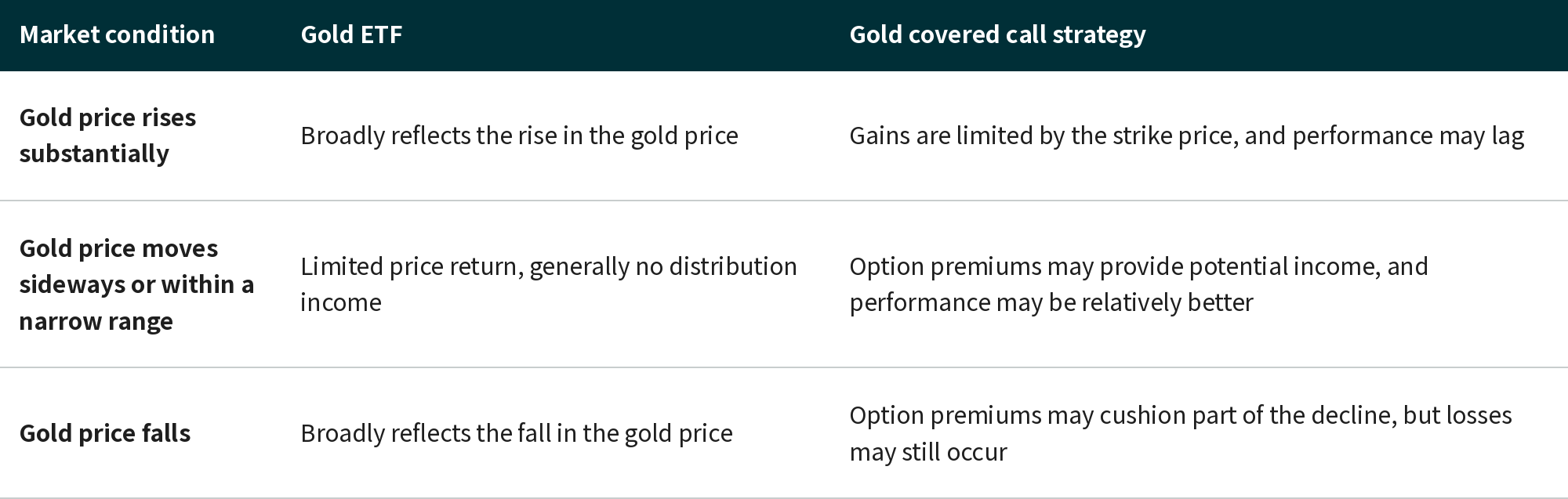
Note: The table above illustrates general principles only. It does not represent the actual performance of any product and does not constitute investment advice.
Three Things to Understand Before Seeking Income
First, a positive distribution yield does not imply a positive return. Every dollar a fund distributes is paid from the fund’s assets, and the fund’s net asset value is reduced accordingly after each distribution. If the gold price falls at the same time, the overall investment may still record a loss even after receiving distributions. Returns should be assessed on a “total return” basis (price changes plus distributions), rather than on the distribution yield alone.
Second, distributions may be paid out of capital. Some products may pay distributions out of capital. This amounts to returning part of the investor’s original investment and may result in an immediate reduction in the net asset value per share.
Third, distribution amounts are not fixed. The size of option premiums is affected by market volatility. Distribution rates may change with market conditions and are not guaranteed.
Each Strategy Has Its Strengths. The Key Is Matching Your Own Goals
Investors who are positive on gold’s long-term outlook and wish to benefit as much as possible when the gold price rises may find a gold ETF closer to their needs. Investors who expect the gold price to fluctuate in the short term and wish to have some cash flow while holding gold may further explore the covered call strategy.
Investors do not have to choose only one. Some investors hold a gold ETF to retain the opportunity to participate in gains, and also allocate to a covered call strategy to seek potential income.
Whichever strategy is chosen, gold is only one part of an investment portfolio. Investors may first want to clarify whether they are seeking “upside” or “cash flow”, then decide on their allocation based on their own risk tolerance and financial goals.
Currently, ETFs using a gold covered call strategy are available in the Hong Kong market, such as the Global X Gold Covered Call Active ETF* (3533) (*This is a synthetic ETF). The ETF obtains exposure to gold performance and the returns of the covered call strategy mainly through total return swaps, and is therefore exposed to counterparty risk. Investors should refer to the website for relevant information and risk factors: https://www.globalxetfs.com.hk/funds/gold-covered-call-active-etf/



 (852)3555 5888

 Leave Us A Note