Important Information
Investors should not base investment decisions on this material alone. Please refer to the Prospectus for details including the product features and the risk factors. Investment involves risks. Past performance is not indicative of future performance. There is no guarantee of the repayment of the principal. Investors should note:
- The investment objective of Global X Hang Seng High Dividend Yield ETF (the “Fund”) is to provide investment results that, before deduction of fees and expenses, closely correspond to the performance of the Hang Seng High Dividend Yield Index.
- Whether or not distributions will be made by the Fund is at the discretion of the Manager taking into account various factors and its own distribution policy. There can be no assurance that the distribution yield of the Fund is the same as that of the Index.
- The Fund may invest in mid-sized companies, which may have lower liquidity and their prices are more volatile to adverse economic developments.
- The Fund invests in the emerging markets which may involve increased risks and special considerations not typically associated with investment in more developed markets, such as liquidity risks, currency risks/control, political and economic uncertainties, legal and taxation risks, settlement risks, custody risk and the likelihood of a high degree of volatility.
- The trading price of the Fund’s unit on the SEHK is driven by secondary market trading factors, which may lead to a substantial premium or discount to the Fund’s net asset value.
- The Manager may at its discretion pay dividends out of the capital of the Fund. Distributions paid out of capital, represent a return of an investor’s original investment or its gains and may potentially reduce the Fund’s Net Asset Value per Share as well as the capital available for future investment.
- The Fund may suffer from a losses or delays when recovering the securities lent out. This may potentially affect its ability to meet payment and redemption obligations. Collateral shortfalls due to inaccurate pricing or change of value of securities lent, may cause significant losses to the Fund.
China’s Macro Environment: A Prime for Dividend Stocks
This year, two intriguing developments in China’s macro environment have emerged, both of which carry significant implications for dividend stock investments.
The first is the surge in oil prices triggered by the Middle Eastern conflict. Under normal circumstances, a country heavily reliant on imported crude oil like China should experience rising government bond yields and a weakening currency. However, Chinese government bond yields have surprisingly declined since March. China stands alone as the only major economy to see its yields drop while those of the U.S., U.K., and Japan rose in tandem. Specifically, the 10-year Chinese Government Bond yield, which ended 2025 at approximately 1.8%, has fallen to roughly 1.7% as of July 30.
The Yuan has also shown exceptional resilience against the strong U.S. dollar, which typically gains momentum during global crises. While nearly all major currencies have faced downward pressure since March, the Yuan has maintained a firm stance against the greenback.
10-year government bond yields have diverged since the middle East conflict
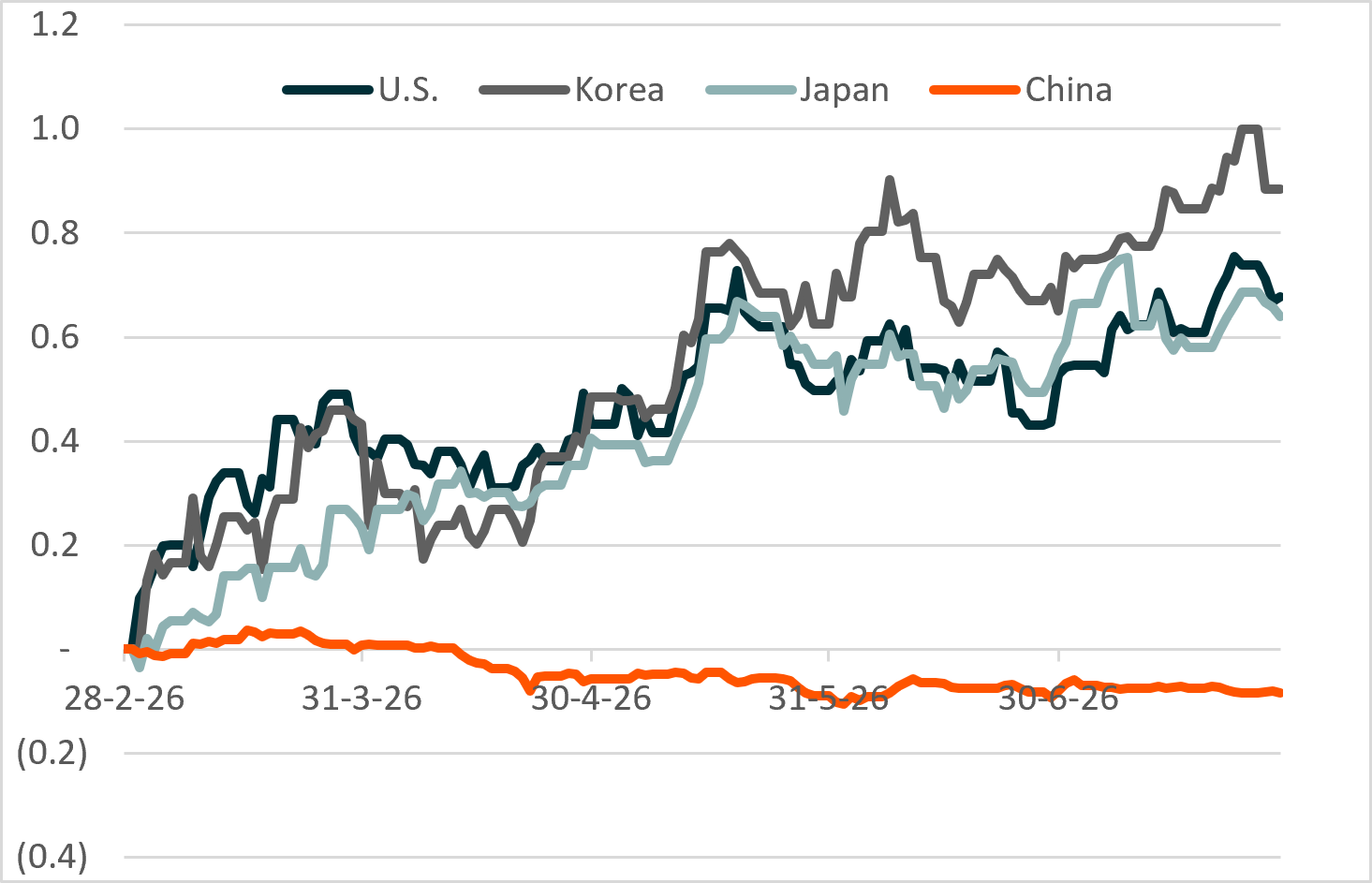
(Source) Bloomberg, 30 July 2026
What exactly is driving these unprecedented shifts and what’s the implication from it?
Energy Decoupling
First, this shift demonstrates that the Chinese economy has become increasingly decoupled from external shocks, such as oil price volatility. Over the past decade, China has expanded solar, wind, and nuclear power capacities while accelerating electric vehicle adoption, steadily reducing its crude oil demand per unit of GDP. In fact, China’s refined oil consumption decreased by 3.5% YoY in 2025. This downward trend is expected to accelerate in 2026, with oil consumption forecast to drop by 5% as EV penetration continues to rise. While approximately 85% of vehicles currently on the Chinese road are internal combustion engines, the landscape is shifting rapidly given that EVs accounted for more than half of all new car sales in 2025. According to government plans, new energy vehicles will represent 30% of the nation’s total vehicle fleet by 2030, which will further curb global oil demand.
The “Good” Deflation: Structural Drivers of China’s Cost Competitiveness
Second, China possesses abundant internal factors that offset the impact of rising oil prices. While certain types of deflation can be “bad”, China is also experiencing a “good” deflation characterized by productivity gains.
For example, electricity tariff is not a driver of inflation in China. This stability is primarily due to the massive expansion of solar and wind power, which now offer lower electricity generation costs than traditional coal-fired plants. As these renewable installations expand, China’s average power generation cost continues to decline, providing a significant advantage for manufacturing firms in managing their operational expenses. Very few nations globally have matched China’s success in stabilizing electricity cost.
Food prices follow a similar trend. Over the past twenty years, Chinese agriculture has modernized rapidly, establishing large-scale, high-efficiency systems. A prime example is the construction of 26-story “pig skyscrapers” in Hubei Province, which utilize advanced automation and AI-driven monitoring to mass-produce livestock at lower unit costs. Fruit cultivation in China has also shifted toward large-scale industrial models, increasing output and preventing the price spikes that typically accompany rising income levels.
Furthermore, the rising healthcare costs that plague many developed nations remain a distant concern for China. While increasing incomes usually lead to a surge in medical demand and prices, China has implemented aggressive government-led price reductions over the past decade. Simultaneously, China’s domestic capacity for innovative drug development has matured; expensive imported pharmaceuticals are increasingly replaced by domestic alternatives that often cost only 10% to 30% of their U.S. counterparts. This environment has successfully prevented medical inflation from taking root.
These “beneficial deflationary” factors collectively serve as the foundation for China’s manufacturing cost competitiveness. This structural advantage was a major contributor to China achieving a record $1.2 trillion trade surplus in 2025.
China’s cost competitiveness has enabled decent economic growth like a 5% GDP expansion in 2025. Notably, net exports were a primary engine of this growth, contributing 33% to the total GDP increase in 2025—the highest level since 1998. Moving into 2026, robust manufacturing exports continue to underpin the 4~5% growth rate for 2026.
This fundamental strength explains why the Yuan has maintained its firm trajectory despite the widening interest rate differential between U.S. and China government bonds, which exceeds -2.9% p.
Modest Growth and Dividend Strategies
However, is it possible for China to re-enter a high-growth trajectory of, say, 5% or more if a new economic cycle begins?
Given the current conditions, achieving growth above 5% appears increasingly difficult. First, the industrial ecosystem continues to grapple with overcapacity. Second, the government is prioritizing high-quality growth over stimulus-driven expansion. If the economy show signs of overheating, the government will likely reduce its support policies, such as the issuance of ultra-long-term special bonds previously used for local government assistance.
In this environment, where inflation and interest rates remain low while growth persists at a steady 4%, investments in consumer related goods are not ideal. The consumer sector typically requires a surge in aggregate demand that outpaces supply to drive profitability.
Conversely, these conditions are highly favorable for dividend stocks. Dividend yields have become exceptionally attractive compared to government bond yields, and since the risk of a sharp economic downturn is mitigated by resilient growth, the likelihood of a sudden reduction in payout ratios is low.
Furthermore, as Chinese equities remain undervalued compared to global markets, the number of stocks with dividend yields exceeding 6.0% is significantly higher than in other major stock markets. While these companies may have boring revenue growth, they continue to provide consistent distributions backed by resilient economic conditions.
Government 10 year yield vs. Hang Seng High Dividend Yield index’s Gross Dividend Yield
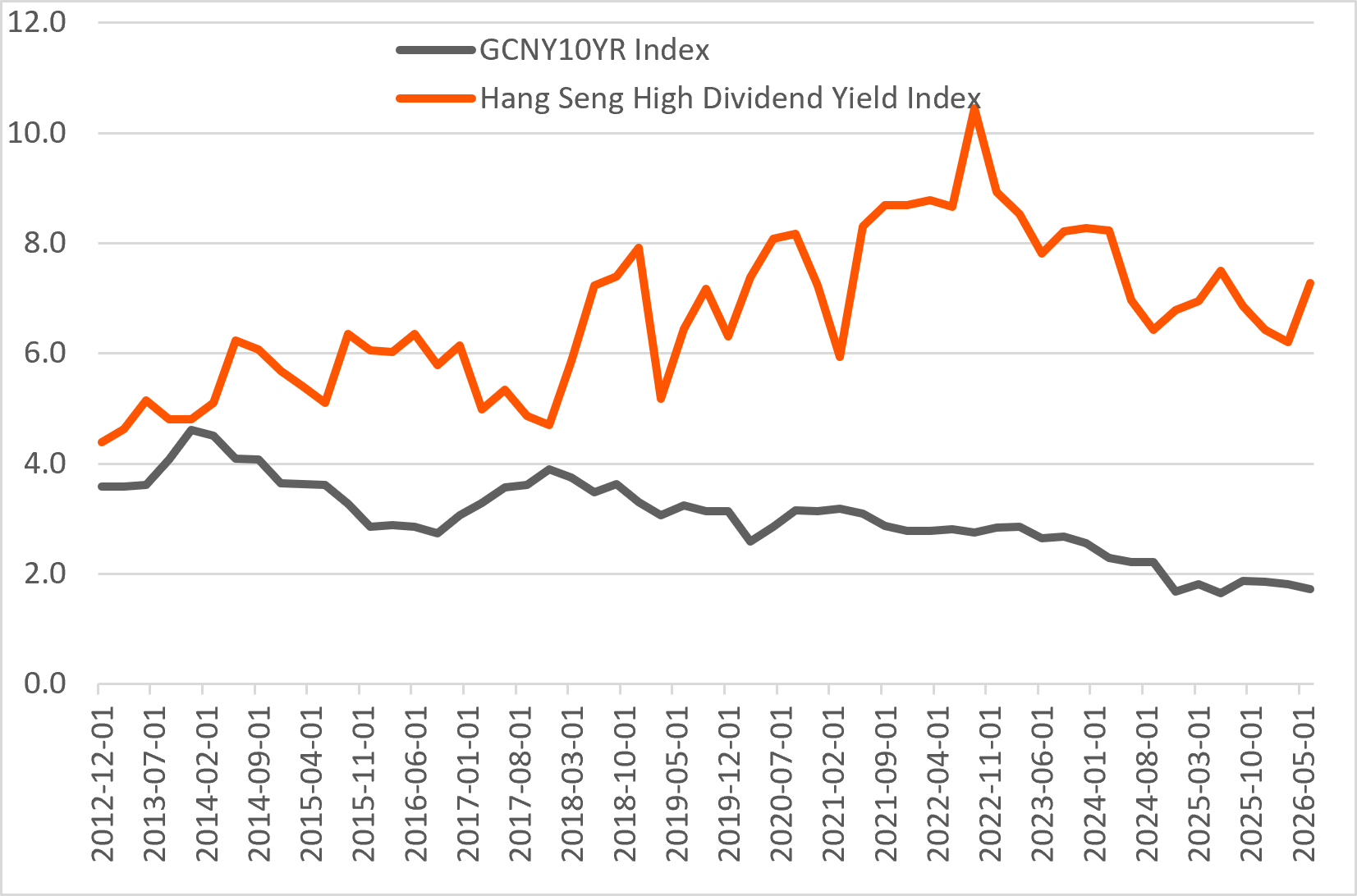
(Source) Bloomberg, July 2026, (Note) gross dividend yield refers to the pre-tax dividend paid over the last 12 months divided by the current share price



 (852)3555 5888
 Leave Us A Note