Important Information
Investors should not base investment decisions on this website alone. Please refer to the Prospectus for details including the product features and the risk factors. Investment involves risks. Past performance is not indicative of future performance. There is no guarantee of the repayment of the principal. Investors should note:
- The investment objective of the Global X Copper Miners ETF (the “Fund”) is to provide investment results that, before fees and expenses, closely correspond to the performance of the Solactive Copper Miners Index (the “Index”).
- The Index is a new index and has minimal operating history by which investors can evaluate its previous performance. The Fund may be riskier than other exchange traded funds tracking more established indices with longer operating history.
- The Index constituents may be concentrated in copper ore mining and/or copper-derived structural shape manufacturing, which may potentially be more volatile than a fund with a diversified portfolio.
- The Fund may invest in small and/or mid-sized companies, which may have lower liquidity and their prices are more volatile to adverse economic developments.
- Investment in Emerging Market may involve increased risks and special considerations not typically associated with investments in more developed markets, such as liquidity risk, currency risks, political uncertainties, legal and taxation risks, and the likelihood of a high degree of volatility.
- The base currency of the Fund is USD but the trading currencies of the Fund are in HKD and USD. The NAV of the Fund and its performance may be affected by fluctuations in the exchange rates between these currencies and the base currency and by changes in exchange rate controls.
- The trading price of the Fund’s unit on the SEHK is driven by secondary market trading factors, which may lead to a substantial premium or discount to the Fund’s net asset value.
- The Manager may at its discretion pay dividends out of the capital of the Fund. Distributions paid out of capital, represent a return of an investor’s original investment or its gains and may potentially reduce the Fund’s Net Asset Value per Share as well as the capital available for future investment.
- The Fund may suffer from losses or delays when recovering the securities lent out. This may potentially affect its ability to meet payment and redemption obligations. Collateral shortfalls due to inaccurate pricing or change of value of securities lent, may cause significant losses to the Fund.
- The investment objective of Global X S&P Crude Oil Futures Enhanced ER ETF (the “Fund”) is to provide investment results that, before deduction of fees and expenses, closely correspond to the performance of the S&P GSCI Crude Oil Enhanced Index Excess Return.
- As the exposure of the Fund is concentrated in the crude oil market, it is more susceptible to the effects of crude oil price volatility than more diversified funds.
- Crude oil prices are highly volatile and may fluctuate widely and may be affected by numerous events or factors such as crude oil production and sale, complex interaction of supply and demand of crude oil, weather, crude oil inventory level, war, speculator’s activities, Organization of the Petroleum Exporting Countries’ behaviour andcontrol, economic activity of significant crude oil use country and other financial market factors.
- The exposure of the Fund is concentrated in the crude oil market, it is more susceptible to the effects of crude oil price volatility than more diversified funds.
- Investment in futures contracts involves specific risks such as high volatility, leverage, rollover and margin risks.
- The trading price of the Fund’s unit on the SEHK is driven by secondary market trading factors, which may lead to a substantial premium or discount to the Fund’s net asset value.
- The investment objective of Global X Gold Covered Call Active ETF (the “Fund”)* (*This is a synthetic ETF) is to generate income by primarily providing exposure to gold futures and/or exchange traded funds tracking the price of gold (collectively, the “Gold Performance”) with a covered call strategy. The Fund will use a synthetic investment strategy by investing up to 100% of its Net Asset Value in fully funded total return swaps.
- This synthetic investment strategy exposes the Fund to counterparty risk including under collateralisation risk, default risk, intra-day counterparty risk, early termination of swaps risk and change of swap fees risk.
- The Fund invests more than 50% and up to 100% of its Net Asset Value in FDIs. Associated risks include counterparty/credit risk, liquidity risk, valuation risk, volatility risk and over-the-counter transaction risk.
- The Fund employs an actively managed investment strategy. The Fund may fail to meet its objective as a result of the implementation of investment process which may cause the Fund to underperform as compared to direct investments in the constituent equity securities of the Reference Index.
- The Fund’s opportunity to benefit from the increases in the Gold Performance will be limited the strike price of the referenced Gold Call Options plus the notional premium. In rapidly rising markets, this limitation may result in the Fund underperforming the Gold Performance. Conversely, the Fund remains exposed to declines in the Gold Performance, as the covered call strategy embedded in the swap does not provide full downside protection.
- If the fund is unable to obtain sufficient exposure to Gold Performance due to the limited availability of swaps, the Fund may suspend creations, which could cause the Fund to trade at a significant premium or discount.
- The investments of the Sub-Fund are concentrated in the performance of gold generally and will result in large concentration risk.
- Potential conflicts of interest may arise as the Manager and one of the Swap Counterparties are members of the same group.
- The markets on which the gold futures, Gold ETFs and listed Gold Call Options are traded and the SEHK may have different trading hours. The Fund’s value may change on days when investors will not be able to purchase or sell the Fund’s Shares.
- The trading price of the Fund’s unit on the SEHK is driven by secondary market trading factors, which may lead to a substantial premium or discount to the Fund’s net asset value.
- The Fund may be terminated early under certain circumstances (e.g., if NAV falls below HK$50 million), which could result in a loss of investment.
- The Manager may at its discretion pay dividends out of the capital of the Fund. Distributions paid out of capital, represent a return of an investor’s original investment or its gains and may potentially reduce the Fund’s Net Asset Value per Share as well as the capital available for future investment.
Three Barriers to Commodity Investing, and How ETFs Address Them
“I want to buy gold but I hate that it doesn’t pay any dividends. Is there a way to get gold exposure and regular income while navigating price uncertainty? ”
“Everyone says AI and the power grid need copper. But how should I invest in copper?”
“I bought an oil ETF because I expected oil prices to rise. They did, but my returns didn’t seem to keep up.”
…
These are questions we have often heard from investors recently. Commodities have become a market focus, and more investors are looking to participate. However, holding commodities directly is often far from simple, which is why more investors are choosing to access commodity markets through ETFs.
Commodities: an important part of a portfolio
Commodities deserve attention, first because they tend to move differently from equities and bonds. Commodity prices are driven mainly by supply and demand, weather and geopolitics, and are relatively indirectly linked to corporate earnings and the interest rate cycle. When equities and bonds come under pressure, commodities may move in a different direction, helping to diversify a portfolio.
Second, raw material prices often respond first when inflation rises, which is why many investors see commodities as one way to manage inflation. Long-term trends such as AI data centres, power grid upgrades and electric vehicles also require large quantities of metals, and commodities have regained investor attention in recent years.
That said, commodities pay no dividends and generate no earnings of their own. Returns come mainly from price movements, which can be significant. Before allocating to commodities, investors should understand the role they play in a portfolio and assess how much volatility they can tolerate. While commodities deserve attention, their physical nature also creates real barriers to investing in them directly.
What are the barriers to investing in commodities directly?
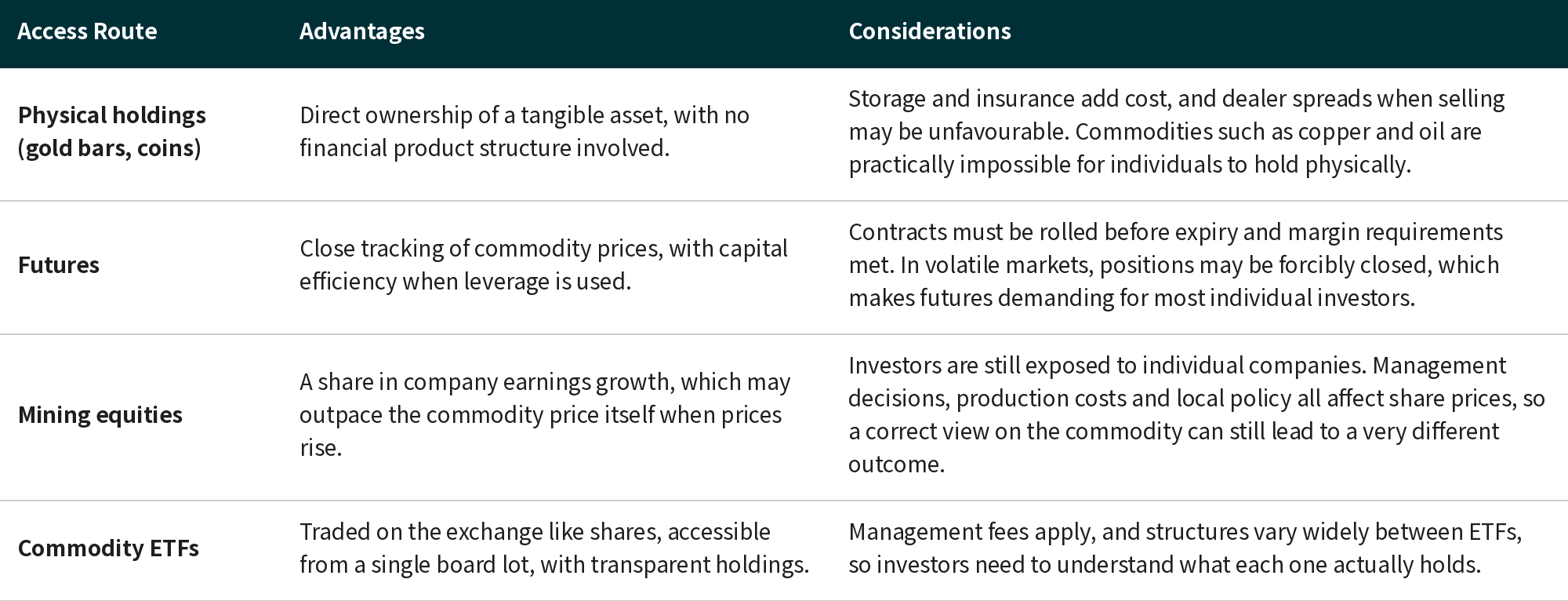
Traditionally, investors have accessed commodity markets through physical holdings, futures or mining equities, but each route comes with its own barriers. The table below compares these three routes with commodity ETFs.
Commodity ETFs: lowering the barriers to commodity investing
Commodity ETFs are drawing growing investor interest because they offer a simpler way to address these barriers.
Want exposure to gold without dealing with storage and insurance? A physically backed ETF holds and stores the metal on the fund’s behalf, so investors do not need to handle it themselves.
Have a view on oil but unfamiliar with futures rolls and margin? A futures-based ETF manages the contracts within the fund, so investors do not need to open a futures account or meet margin requirements.
Want to participate in copper’s long-term trend but unsure which miner to choose? A mining equity ETF invests in a basket of mining companies, so investors do not need to research individual companies, and single-company risk is diversified.
Just as importantly, all these commodity ETFs can be traded on the exchange through a standard securities account, accessible from a single board lot, with transparent holdings. In short, ETFs lower the barrier to commodity investing.
Using commodity ETFs well: understand the structure first
What many investors overlook, however, is that commodity ETFs use more than one investment approach, and their performance can differ significantly.
Some ETFs hold the physical commodity directly, such as gold stored in a vault, and tend to track spot prices closely. Others track prices through futures, where roll costs come into play. If next month’s contract is priced above the current one, each roll effectively means selling low and buying high. Over time, this may cause the fund to lag the spot price reported in the news. This often explains the experience mentioned at the start: oil prices rose, but returns did not keep up.
Other ETFs invest in a basket of mining companies. Miners have what is known as operating leverage. When commodity prices rise, their selling prices adjust immediately, while costs such as labour, equipment and energy may not rise at the same pace in the short term. As a result, earnings growth may outpace the commodity price. However, operating leverage cuts both ways, and earnings may fall more sharply when commodity prices decline.
Some products also adopt a covered call strategy. The fund holds the underlying asset while selling call options to collect premium, giving up part of the upside potential in exchange for more stable cash flow. This approach may suit investors who prioritise income.
When selecting a commodity ETF, therefore, fees are only part of the picture. What matters more is understanding what the ETF actually holds, and whether that structure fits the investor’s objective, whether that is diversification, exposure to long-term trends or income.
At Global X, innovation goes hand in hand with clarity.
Before investors make a decision, we want them to understand the structure, characteristics and risks of the tools they use. This principle guides how we build our commodity ETF range. Commodity ETFs can be built on physical, futures, mining equity or income strategies, and each one serves a different investment need. As a permanent innovator, we aim to go beyond ordinary ETFs by offering simple, transparent solutions that open up commodity markets, once mainly the domain of institutions, to investors in Hong Kong.
For more information and risk disclosures: https://www.globalxetfs.com.hk/fundlist/



 (852)3555 5888

 Leave Us A Note